2005/11/14

One Year of Le Monde 2

Another year has gone by since we last read about Le Monde's weekly magazine. See if you can discern any patterns in France's independent newspaper.… In issue 38 (November 6, 2004), the newspaper of reference has Eric Leser interview Danny Schechter for an article on his Weapons of Mass Deception and "the excesses of the American media system". (Sample question: "Are the media in the hands of the administration?") Pierre Jullien devotes the archive section to the CFDT union. (Sample caption: "that humanist [secretary general Eugène Descamps] famed for shouting his mouth off was the embodiment of an authentic and generous unionization.")

Echoing François Hollande on the results of the American election (the foremost explanation for the Republican victory, said the Socialists' leader, was due to "the reflex of fear" in America), Issue 39 (November 13) has Edwy Plenel explaining that Dubya's victory is due, basically, to Americans being frightened and/or bamboozled by Karl Rove and his ilk (reality check here), comparing the discourse on moral values with the speeches of Nazi-collaborator Philippe Pétain. (When Bush isn't being compared to Hitler, he is being compared to a Stalinist or a fascist sympathizer…) But the Bush-bashing does not end there.

The issue features Annick Cojean's cover interview with Elton John, in which two pages are devoted to politics; sarcasm concerning the "land of liberty"; condescension regarding a "system" that would allow a man like George W Bush to be elected; self-praise for EJ being "dead-set against the Iraq war from the very beginning"; head-shaking about how one would go crazy if one "lived in America full-time"; harping about "one of the greatest tragedies of all time" (Dubya's election) and for the biased information on American TV channels and the "infinitely dangerous" "mental cases" who work for them. (Cojean even manages to fit in a question concerning criticism of Ronald Reagan.) "Impossible to understand for a European or simply someone with common sense." Notice how a citizen of Europe, by very definition, is a wise, tolerant, and reasonable person with common sense… (Le Monde 2 sure refrained from reporting on whom he received an award from!)

Before we have a chance to coo over Alain Frachon's photo album on Yasser Arafat coupled with Shlomo Ben-Ami's article on the Palestinian Ra'is, we get to read Jan Krauze's interview of "the American who rejects the American model". Indeed, long-time International Herald Tribune columnist William Pfaff holds that "the leaders of his country are committing a major historical mistake in considering that the United States have the vocation to propose, even to impose, ther model of society to the entire world." Since he says that "people over there [in the U.S.] do not understand what one is telling them"; since he believes that "globalization is destabilizing"; since he claims that the neocons are naive and that "realism" has become a pejorative word in Washington; since he skewers the evangelical movement; since he says that "France has committed some tactical errors but fundamentally its position was just"; since he says that "the fundamental problem is that the United States doesn't understand that the essential cause of the current problems in Iraq is the occupation itself"; since he compares the American way of life to communist totalitarianism ("this manner of considering the American way of life as a stage to come for all humanity, that is the American counterpart of Marxism")… he is a natural subject for an interview by the independent newspaper

In Issue 41 (November 27), Edwy Plenel complains that in spite of "Michel Barnier having said that France's message has been 'heard'," France is more and more isolated. Ranting and raving that it's unjust, he goes on to suggest that France's position in Ivory Coast is the fault of (who else?) treacherous America. "Isn't that [France's position of a neocolonist power] what the United States was seeking, that opportune ally of Laurent Gbagbo? Install that image, efficient as a caricature: the old colonial Europe face to face with the new democratic empire?" The French are so used to caricaturing Uncle Sam and Bush, and to treachery and double-dealing, that they automatically bestow the same attributes on anybody who doesn't agree with them (by sheer coincidence, this self-serving viewpoint leaves the French — or their leaders and élite — off the hook)…

Otherwise, Corentin Fleury has been kind enough to accompany the "mujaheeddin" in their fight for "besieged" Fallujah; meeting them for real, says the 21-year-old photographer, "suddenly those fanatics had a human face, that of fighters who have crossed three or four countries to 'defend Islam' against, they said, the 'heathens' and to free the country from the 'invaders'." Although the Frenchman goes on to talk about "the young fighters and the foreigners, all those who were ready to sacrifice their lives", the article's subhead does — surprizingly — mention "the fundamentalist Sunni [who] have installed a true dictatorship, multiplying cases of torture and executions."

There is also Michel Guerrin and Emmanuelle Lepic's interview with Gilbert & George, two London-based artists who, not unsurprisingly, are against George W Bush (and the Pope, who should "be sent to the international criminal court for crimes against humanity").

In issue 42 (December 4), Martine Valo's article on Belgian artists working in France would hardly be complete if they didn't bash Bush, while in Issue 43 (December 11), Pierre Assouline claims that because so many members of the French élite teach in America, there can be no truth to the charge that the French are anti-American. (We also learn that not only Nicolas Sarkozy is known as l'Américain; Nicolas Bourcier teaches us that in Turkey, a writer is also known as "the American". Happily, Orhan Pamuk is against the "terrible" George W Bush "who builds a ditch between East and West".)

Issue 44 (December 18) has articles about 7 Jours au Groland, Canal +'s TV news parody that takes on "the establishment, the free market, the executive class, Bush's policies, comfort and conformity" (Jean-Michel Normand); and buyers in a Paris market asked (by Amélie Amiel and Fabien Breuvart) to take their own photos.

Horrors! In the archives section, Michel Lebvre informs us that the Le Monde 2 weekly had a predecessor in the 1940s (entitled Une Semaine dans le Monde). Listen to a sample sentence: "Le gouvernement des Etats-Unis a enfin compris — puisse le Congrès en faire autant — que l'existence d'une Europe indépendante et relativement prospère importait beaucoup à la paix du monde et à la santé de l'Amérique elle-même ; c'est un premier pas." Does the condescension ring a bell? It's from July 1947.

In Issue 45 (December 24), Edwy Plenel waxes enthusiastically about the lessons of life from two leftist intellectuals, while Simon Roger's archive section takes on Zapata and la revolución mexicana… A week later, Issue 46 (December 31) presents us with the photos of the year 2004. Besides the picture of the coffin of Ronald Reagan is a caption informing us that the president died at the age of 83. As for Edwy Plenel, his editorial on the Bantu word Ubuntu (fellowship) pontificates that South Africa is replete with brotherhood and humanity and that the Reverend Tutu's Truth and Reconciliation Commission is (nudge, nudge) "far from any simplification between Good and Evil". And the condescending editor goes on to add that "In Iraq, liberated but occupied, where the trial of Saddam Hussein is announced before a 'special tribunal' with the option to impose the death penalty, the South African example has not, alas, taught any lessons." Marveling at a supposedly exemplary reconciliation program in Morocco, Plenel goes to suggest that that Arab country has learned more from that example than Iraq or …the United States.

Issue 47 (January 8, 2005) has an Edwy Plenel editorial saying basically that compared with the victims of the tsunami, the victims of 911 don't represent much (although this is preceded by the usual batch of hedges and disclaimers)… Issue 49 (January 22) features Caroline Broué's interview with Baltasar Garzón, the Spanish judge who has gone after former autocrats (Pinochet and members of the Argentinian junta), but has done nothing against current ones (Fidel Castro). Lauding "Chirac, Zapatero, Brazil's Lula, and Chile's Lagos", the good judge takes as a given the Lancet canard that "the liberation of a country [Iraq] cost the lives of over 100,000 people" and says that that is something he "cannot accept". Nor could Spain's highest antiterrorism magistrate accept the 3,200 dead under Pinochet. But the 20,000 under Castro, es un otra historia

Lucie Werther has excerpts from her journal relating on her experience as a Frenchwoman living in Riyad (the cover article), in which she complains about disinformation about France as an anti-Muslim country. Disinformation — something to fight against. Francesco Zitrola follows that with an article following a team of Doctors without Borders to tsunami-struck Indonesia, in "the humanitarian wave". Unless I am mistaken, apart for the Presbyterian Purse, the words "America", "Americans", "U.S. Navy", "the Abraham Lincoln" are not mentioned once…

The cover story of Issue 48 (January 15) concerns the residents of the rich new boomburbs who voted for George W Bush. Needless to say, Corine Lesnes manages to find a family in Colorado whose children have never been to the East Coast or even abroad. Of course, had the Kurtenbachs managed to travel a bit, they would have acquired the lucid open-mindedness that is so prevalent among avant-garde Europeans and voted for John Kerry. This is followed by Khassan Baïev's testimony from his tour of Chechnya as a surgeon, Philip Blenkinsop's photos from tsuanami-stricken Atjeh (Indonesia), and Mark Power's pictures of the Airbus A380. The super-jumbo (shouldn't we call it the hyper jumbo jet?) being European (and not American), there is nothing about the pollution it will produce.

The special archives section, surprisingly, is dedicated to a single person, and somone by no means considered one of the century's most important leaders. But that's forgetting that Paul Newman is not only a proudly self-proclaimed Democrat, he did things like oppose the Vietnam war and help put the Nation back on track, and above all, he is "ashamed of the aggressiveness of President Bush". Noting that an actor was elected president in 1980, the author bemoaned the fact that that actor was a war-mongering, free-market conservative. Wouldn't it have been much better, for America and for the world, had a Hollywood star with the credentials of Newman made it to the White House? "The 'and if' is fascinating" purrs Jasper Gerard. "Imagine if the leftist screen idol had won over Ronald Reagan, conservative and B-movie actor. How different would the world be?" Imagine: President Newman. Imagine: intercontinental peace and harmony with the entire planet. Imagine: the USSR still in existence. Makes your smile sugary and your eyes water…

I didn't do too well on recording all of the following issues, but relaed to the above, the cover article of issue 58 concerned Hillary Clinton, fawning about her chances in 2008 and how good she would be for America and for the world.

Issue 50 (January 29) has Maguy Day and Stéphane Jungers's map of Iraq entitled "Elections in blood", followed by "the investigation of an Iraqi doctor" on Fallujah, City of Ghosts, a translated Guardian article in which Ali Fadhil describes how the Sunni city was "completely destroyed" and how "the American military have assuredly sown the grains of a civil war".

In Issue 51 (February 5), Yann Plougastel interviews Manu Chao, aka "the José Bové of music", while Plenel waxes poetically on Florence Aubenas: her rigor and humanity, the coupling of professionalism and generosity in her writings, her laughter, her vivacité, her joie de vivre, her vital militantism, "the disasters of the world and the misery of the present that she enver ceased to confront". Far from us to minimize the drama and tragedy of her and her chauffeur's kidnappings, but this looks like little more than a rehash of the toasts, the celebrations, and the elegies of so many humanists and other "militants" in the past. And what they usually mean is that the people thus lionized were eager to castigate and/or mock America and capitalist society, while ignoring or relativizing the mass murders and other horrors of dictators opposed to Uncle Sam (Stalin, Mao, Saddam, etc).

Besides Madeleine Vatel's article on "the mother of all Russian soldiers" (aka Valentina Melnikova), Issue 52 (February 12) sports an article on "the most famous English-speaking blogger in Iraq". No, it is not Iraq the Model, it is Healing Iraq, and for the second time, Frédéric Joignot writes about Iraqi blogs without mentioning the site(s) of brothers Mohammed, Omar, and Ali. He makes a point of saying that "the Americans find no redemption in [Zeyad's] eyes." In fact, the journalist spends an entire third of his article in recounting the terrible treatment the Baghdad dentist underwent in the hands of four GIs one night, even pointing out the date of the posting so that the average Le Monde 2 reader can find it easily. The rest of the article is made up of three recent posts which pretty much contradict the anti-American emphasis of the article.

My mother was in tears watching the scenes from all over the country. Iraqis had voted for peace and for a better future, despite the surrounding madness. I sincerely hope this small step would be the start of much bolder ones, and that the minority which insists on enslaving the majority of Iraqis would soon realise that all that they have accomplished till now is in vain
But the large-lettered one-sentence excerpts naturally dwell on the problems due to the American intervention.

Issue 53 (February 17) has Edwy Plenel lecture Bush and Rice about inequalities and a world more unequal than ever. (First he complains about Dubya being a reactionary, now he complains that Dubya wants to reorganize the world…) In issue 54 (February 25), Frédéric Joignot cannot speak with Taslima Nasreen without prompting her to castigate W, serving us the old canard that America contributed to creating the Taliban and the Muslim world's fundamentalists. The atheist Bengladesh writer goes on to claim that "The Baathist party, Saddam's, was a non-religious party [laïque], he opened the university to women, he removed their veils, and now…" (Here is more on Saddam and his family's contributions to feminism and progress in Iraq.) The issue ends with a piece by Pascal Bruckner, the author who tells of the travails he went through for supporting the Iraq War in France.

I learned what it is to get insulted in the street, threats on the telephone. My North African friends told me, "You have brain damage", those of the Esprit review dropped me. … I felt very alone. I asked myself: "Have I made a huge blunder?"
Truly it is nice to hear how open and tolerant the generous, avant-garde humanists are towards the free debate and understanding discussion they are always championing, n'est-ce pas? Unfortunately, Bruckner (who has an American, "strongly anti-Bush" wife) apparently couldn't stand the heat, he did not answer Non to the question he asked himself, and it is truly disappointing to hear how he has back-pedalled, in order to conform to the usual hems and haws of the bien-pensants, and issuing the usual batch of hedges and disclaimers:
I am not ready to engage myself for such causes again.

Historical action is something that [only] occurs in America. Unfortunately.

I gave the impression that I was championing a guy like Bush, whom in the final analysis I hate.

By issue 56 (March 5), I was getting tired of recording all the nonsense in Le Monde 2, and I started slowing down. Edwy Plenel waxes on the recently-deceased Arthur Miller and his brilliant battles against lies in politics and the actors who govern us (can Dubya's name be far away? non…). There is also a long article on Clint Eastwood, and since the movie star is known to be rather of the conservative bent, Samuel Blumenfeld asks him no questions on George W Bush (unless of course he edited them out before publication). The issue ends with a rather interesting archive section on les nouveaux intellectuels (including a pro-war piece by Pascal Bruckner before the unrelenting pressure and the unceasing taunts caused him to relent — see issue 53).

Issue 60 (April 9) has Annick Cojean's cover story on Arnold Schwarzenegger, a Magnum photo reportage on Hezbollah, Martine Valo's article on African singers (Didier Awadi has George Bush jeered in his concerts), and an archive section on the Condor Plan. Last but not least, in a letter to the editor, a Françoise Heide lauds the average French believers who, reminding their atheist counterparts (lauded by Michel Onfray in the previous issue), that "as the well-behaved children of the French Republic that they [the believers] are, very frequently feel the need to tell George Bush to give back to Jesus what belongs to Jesus."

Issue 61 (April 16) features Dominique Frétard's piece on the Berlin exhibit devoted to art on the Baader gang and a portfolio by the photographer Olivier Jobard on an African migrant's attempts to reach Europe.

Issue 62 (April 23) features Guillaume Serina's interview with Marcel Gauchet, the philosopher who wants a world government. "The 21st century will be that of the democratic planet", says the writer of the review Débat. The issue's archives section takes on the fall of Berlin 60 years earlier, with much raised heaped upon the Red Army. (Most interesting — especially in view of all the ink that has been used on trying to prove that the raising of the Stars and Stripes over Iwo Jima was staged — is the portfolio showing TASS photographer Evgenni Khaldei and three Russian soldiers carrying a red banner around Berlin [to the airport, to the Brandenburg gate and that, a day or two after the battle was over] before settling on the triumphant picture taken from the roof of the airport.)

Besides a story on Nollywood, Nigeria's movie industry, in Issue 63 (April 30), we get a huge retrospective on the fall of Saigon. But the best part is that Edwy Plenel takes us to the theater. "What purpose does theater serve?" he asks. "To stir up ideas." So he brings us to a "militant" and "edifying" play, namely Michel Vinaver's 11 September 2001. The Los Angeles première of the play — which (surprise, surprise) likens Dubya to Osama bin Laden — was to be sponsored by …the cultural section of the French embassy in Washington ("which was all to France's honor"), until ambassador Jean-David Lafitte pulled the plugs, an "act of censorship", Plenel informs us (and deplores), "which surprizes us all the more". Still, the "spectacle is reassuring: Vinaver's theater continues to scandalize" although it also means that "one cannot support reality."

Issue 64 (May 7) has a cover story on Neuilly, "the town that votes for Sarkozy [as National Assembly representative] at a rate of 83%", a typical msm piece by Jean-Michel Normand and Martine Valo quoting renowned pundits such as Olivier Besancenot (the Paris suburb is "a ghetto for rich people", opines the leader of the extreme communist party). This is followed by Frédéric Joignot's interview with a "Euro-enthusiastic" American. Needless to say, Jeremy Rifkin castigates America and… George W Bush. If the EU constitution had been proposed in America, adds the Jimmy Carter fan, "I would embrace the document, thinking I had awoken in paradise!" Then in honor of the 30th anniversary of the end of the Vietnam war, Nicolas Bourcier treats us to Marc Riboud's photos of the era and the photographer's reminiscences (we are told that the "citizen photographer" has an "insatiable curiosity" — as you will readily see) of "Uncle Ho" reminiscing in turn on Hue's high school, the charm of the Perfume river, and Maurice Chevalier; of the Ho Chi Minh trail and how "bicycles won the war" ("it was they, coupled with the courage, that incredible doggedness of the North Vietnamese, which beat the forces in the South [the forces, not the human beings] and the Americans"); of North Vietnamese leaving their shelters to fortify the dike of the Red River ("The dike, that is the survival for the whole country"). "On that day [April 30, 1975]", purrs Bourcier, "a war of 30 years comes to an end", by which time the insatiably curious photographer has already left for other horizons.

Besides featuring Hassan Musa's Great American Nude, Issue 68 (June 4) finally brings us stories of American heroics from Iraq. It is the thousands of GIs, Annick Cojean tells us, who have deserted. (Who have deserted "the Iraq war, its horrors, its lies".) Catherine Dupeyron tells us of Khaled Katab Mohameed, the Israeli Arab who would tell his fellow Muslims of the World War II Holocaust; and the archives are devoted to the intellectual Paul Nizan, the first of three LM2 archives devoted to XXth century intellectuals (the two others will be Jean-Paul Sartre and Raymond Aron).

In issue 78 (August 13), Nicolas Bourcier interviews Michael Connelly, the detective novel author (Harry Bosch), who manages to …castigate George W Bush. Claudine Mulard takes on Over There, explaining that the FX show presents a war "that is really not nice to look at". "The first episodes of the ultra-realistic [sic] TV series are provoking a wide debate in the United States: is it a good thing for the morale of public opinion, patriotic in some fashion, to show the horrors of war and the numbness of American troops, almost in real time?" Wow. Mulard, like her lucid compatriots, has really hit the nail on the head: if it weren't for Steve Bochco and his TV series, the average American klutz would have no idea that war is hell. In fact, troops in Iraq will be happy to learn not only of their numbness but how their morale is going to pieces: "Won't the realism of the series undermine the morale of the troops, and thus that of America's public opinion, because it exposes the horrors of a war which the American media outlets refrain from covering in its most harrowing details?" Because, of course, if not for American TV stations' "censorship", the situation would become clear as water, clear in its horror, and all Americans could do nothing but join in agreement with the lucid anti-war Europeans and what the latter have learned from their ultra-objective news media.

Besides Alain Frachon's interview with Pascal Lamy, Issue 80 (August 27) sports Frédéric Joignot's article on Nan Goldin. Needless to say, the American photographer compares the "young Christians" in "conformist" America to neo-Nazis, adding "I don't want to live in the United States as long as George Bush, all those reactionaries who wage war on the entire world, are leading this country." This is followed by her trip to France to do landscapes there, with the article ending with the quote, "It's a new spirituality quest." As if you hadn't understood: the way out of, the solution to, the American nightmare is France: lucid, logical, tolerant, reasonable, harmonious France. The issue ends with a collection of articles on Japan and the end of World War II. Among the articles from the Le Monde archives is a February 1995 article explaining that the emperor's kamikaze-flown planes "sank 34 ships before the end of the war, including 33 aircraft carriers [and] damaged 285, including 36 aircraft carriers" (which gives you an idea of the fact-checking forces available in European editorial offices) and an editorial of September 1, 1945, dealing with the expected "horror" of the (coming) occupation and warning that "neither the months nor the years will probably suffice to fill the gap between the two adversaries which their civilization separates fully". Plus ça change… There is also a filler suggesting the Tokyo trials were not as fair as those of Nuremberg and overemphasized coverage of the Hiroshima and Nagasaki bombings (two articles, fours pages, versus one article of four pages for the entire rest of the war, covering the period 1931- early August 1945), with subheads such as "the 'useless' bomb" and including the only really horrible photos of the issue.

Surprise! The cover article of issue 81 (September 3) features a Nagasaki portfolio ; Frédéric Joignot has an article on the followers of the Raël sect, suggesting that the books of anti-establishment writer Michel Houellebecq are based on their teachings. Fair enough, if true. But it doesn't seem that French society makes a big deal out of all the intellectuals, French and foreign, who through the years based their teachings on the wishes and dictates of Joseph Stalin.

The archives collection of the issue focuses on the birth of Solidarnosc in the Gdansk shipyards 25 years ago. Poles throughout the world will be pleased to learn that Raphaël Chamak and Jan Krauze laud "the stubbornness, the pacifism, and the intelligence of the leaders of the Solidarity union" (emphasis mine), thus suggesting a symbiosis with the anti-war, lucid, and anti-American (sorry, anti-Reagan) forces in Western Europe.

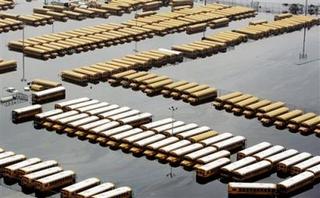
Issue 82 (September 10) is devoted to hurricane-ravaged Louisiana. With Edwy Plenel leaving Le Monde, Jam Krauze takes over, and his first editorial is replete with French paternalism. Wang Fuchun shows off his prize-winning photographs of China's locomotives while Marie Bourreau recounts the story of Sabrina Sagheb, the Afghan basketball player who is the youngest candidate in the legislative elections. Nowhere is there mention of the word America or the war she waged to allow for Sagheb's run, except in the latter's disdainful mention of "the American candidate, Hamid Karzai".

Issue 83 (September 17) features Yann Plugastel's article on the fall and rise of Phill Spector, Jan Krauze's comments on Eric Baudelaire's photos of the ghosts of Abkhazia, and — needless to say — the Alain Salles account of the revolt of America's media:

Showing little eagerness until now to criticize President Bush or to show the horror in Iraq, the most famed TV news presenters have not held back in voicing their indignation [in the wake of Hurricane Katrina]
Most important of all, the cover article concerns Annick Cojean's story about, and exclusive interview of, Hamid Karzai. In striking contrast with French reporters' relations to French politicians and members of the elite (see, for instance, Olivier Todd's description of Jean Daniel in issue 85, below), there is barely a single of her 26 questions with Afghanistan's president over four full pages that does not display deception, pessimism, cynicism, mistrust, and/or smugness. A patient and "always optimistic" Karzai (to noone's surprise) holds his own. The issue's other bright spot is a 1971 interview with Louis de Funès, in which the star comedian defends popular comedy as opposed to the mockery and snorts of the Left's artistes engagés — "laughter at the expense of others, sad laughter, that makes you want to cry".

Prior to Nicolas Bourcier's cover article dedicated to China's influence in Algerian city-building, Issue 84 (September 24) starts out with Alain Frachon's column concluding that if America ever had a "great" president, it was not Bush but Clinton. Follows Frachon's interview with Senegalese writer Ken Bugul, Mattea Battaglia's portfolio of Vincent Prado pictures from his three-year stay among the Maoist guerillas of Nepal, and the archive section dedicated to John Lennon, featuring a 1966 article by Bernard Cassen, many years later president of Attac.

The cover article of Issue 85 (October 1) concerns Matthieu Auzanneau and Guillaume Serina's study on the coming end of the petroleum era. Enough said. While Michel Philippot narrates a portfolio of Brassaï photos, Baudouin Eschapasse has an article on Deep Springs College, "the most prestigious, the most selective, and the strangest school in America." Or: Heidegger with the cowboys…

Speaking of intellectuals, this week's issue features excerpts from Olivier Todd's auto-biography. The son-in-law of Paul Nizan, "incarnation de l'intellectuel engagé", and the father of Emmanuel Todd, Olivier tends to prove that intellectualism in France is a family affair (or should that be a clan affair?). His account of editor Jean Daniel's audience with John Paul II can perhaps be called typical of French journalism:

Jean entitled his article "What the Pope Told Me". Actually, it was mostly about what Jean Daniel had told the Pope.
The elder Todd's most revealing moment, and neither he nor any of his editors (at the book publisher or at Le Monde 2) seem to realize it, comes when he describes the "autocrate eclairé" at Le Nouvel Observateur:
Admiration came easily to Jean [Daniel]. Philosophers as well as politicians, writers as well as philosophers, bowled him over. Those luminaries, Camus, Sartre, Malraux, Pompidou, Giscard, Mitterrand, Foucault, communicated, via porosity, a touch of their talents to him. If he returned from a trip abroad, Jean immediately went to a [government] minister to share his impressions. He made a report.
Then, there is the archives section on the 40th anniversary of coup d'état in Indonesia, the overthrow of Sukarno, and the beginning of the reign of Suharto, with special emphasis, of course, on Washington's role in this "witch hunt". The massacre of thousands of PKI members and sympathizers is depicted as gratuitous without the slightest attempt to touch on the behaviour and attitude of their fellow communists in places such as the Soviet Union, China, and Vietnam.

Speaking of China, for the past few weeks, Le Monde 2 has featured a three-panel comic strip by Marjane Satrapi. The feminist caroonist from Iran ends this week's offering with the following nuanced question

outside of 4-euro T-shirts and 12-euro pairs of shoes, I wonder if it is better to be invaded and dominated by 300 million puritans [America] or by 1 billion atheists [China]?
Hmm. Wonder what the Dalai Lama and the Tibetans would have to say to that piece of moral relativism…

Issue 86 (October 8) features Samuel Blumenfeld's cover article on "God Against Darwin" — subtitled "Bush's America Assault on Evolution"; Jan Krauze couples an editorial ironizing about the new democracies in the former Soviet Union with an article on the Kremlin's gulag; Annick Cojean takes a bite out of Mireille Guiliano's French Women Don't Get Fat.

Issue 87 (October 15) features Martine Valo's story on migrants who have made France their home. Michel Philippot has a gallery of Willy Ronis's photos. Jean Guiloineau has translated Romesh Ratnesar's Time Magazine article on Condi Rice. And Samuel Blumenfeld has an article about what Jane Fonda does not reveal in her autobiography. Even though it reveals that the star "has shown amnesia regarding the most extremists aspects of her political engagement" (the FTA [Fuck the Army] Show, Steelyard Blues, or Letter to Jane, for example, are either ignored or receive but cursory mention), do not expect a conservative reading. Blumenfeld's phrases and sentences include "the American horrors in Vietnam", "the soldiers revolted by the war", and "an actress who found the courage to stand up against the Vietnam war." As for "the actor and director of The Green Berets (1968) — his famous propaganda movie in favor of the American presence in Vietnam", he "is far from having the most nuanced analysis" of the situation and after "Jane Fonda's arrival in Vietnam, John Wayne no longer monopolizes the airwaves." In sum, it amounts to "this aspect of her militantism has been largely struck from her autobiography, as if the extremism that she displayed in a certain era no longer is presentable." In other words, American society — blind, hypocritical, unwilling-to-face-reality American society — is responsible for forcing a courageous actress to lie by omission.

Issue 89 (October 29) gives us Guillaume Serina's interview with Philip Meyer (The Vanishing Newspaper), Philippe Ridet's portfolio on Doctor Nicolas and Mister Sarkozy, Camilla Panhard's article accompanying Mat Jacob's photos of a Muslim community in Mexico ("Allah in the land of the Maya"), Alain Salles' article on Kayla Williams, the former GI in Iraq who "dares break the law of silence" (Love My Rifle More Than You), an archive section devoted to the mystery surrounding the kidnapping and murder of the Algerian leftist opposition leader, Mehdi Ben Barka (one of the sections is entitled "From Mossad to the CIA"), and Annick Cojean's interview with Zaher Shah, most of whose focus is based on the fact that Afghanistan's king speaks French, studied in Paris, and met people like presidents Auriol and de Gaulle ("His reference remained la France").

In Issue 90 (November 5), Jan Krauze lionizes Robert Fisk and his latest book, Bruno Hadjih paints "another viow of Islam", Samuel Blumenfeld interviews Pierre-Andre Taguieff about "demented" conspiracy theorists, and the archives section is devoted to the Nuremberg trials.

We will back track a little, and end this list with Issue 88 (October 22).
Astonishing to see that issue's cover: A black and white photo of Saddam Hussein and the words "The Woman Who Accuses Saddam Hussein"! Have they gotten it, finally? Has the newspaper of reference gotten it? Nicolas Bourcier's article concerns Hania Mufti, the Jordanian at the head of the Iraq file at Human Rights Watch: "The British and the Americans [were able to use her documentation] when the turn came, in early 2003, to justify the invasion of Iraq. … Does she think she may have been manipulated?" Sigh… You won't be surprised that Bourcier refers to the American soldiers as "the occupation troops" and that his piece ends with a comparison between the abuse at Abu Ghraib and the "torture methods of Saddam". In-between, the article goes on to document how Hania Mufti feels let down by the fact that she is not part of the trial of Saddam Hussein, and how that felt like "a slap to the face"… it explains how Iraq was supported by Uncle Sam during the war with Iran. This is intersperced with details of Saddam's horrific crimes. Without saying so outright, Bourcier suggests that it is all America's fault, even if indirectly.

Not once is the word Europe mentioned in Le Monde's article.

Not once is the word France mentioned.

Not once is the name Jacques Chirac mentioned.

Not once.

Le Monde.

France's independent newspaper.

Finally! Le Monde Has Found a Hero From the War in Iraq…

…it is a deserter from the United States army.

And no wonder the man now living in Canada is called a hero. In the daily's Le Monde 2 weekly, Joshua Key is given six pages to write his story of desertion, basically conforting Europeans' simplified and caricatured view of America and the Iraq war (as well as their self-serving view of their own wisdom, courage, and fortitude):

I did not want to return to Iraq. I did not want to participate in this war based on lies. I did not want to kill any Iraqi civilians. I did not want to participate in the slaughter.
The Guthrie, Oklahoma, native goes on to explain how he was "lied" to (when he signed up in February 2002 — five months after 9-11! — the recruiting officer allegedly told him he would never be deployed overseas), how he "was trapped", how the combat engineer was ordered to go on patrols as an infantryman, how the troops behaved "like zombies", how their "uniforms were stained with blood", how buddies "were disappearing one after the other without any word from or about them", and how he "can live with this [his desertion]. Not with Iraq."

The piece (from an issue from early June also featuring Hassan Musa's Great American Nude and which also had shorter testimonials from Jeremy Hinzman, Darrell [mispelled Darrel] Anderson, and Lee Zaslofsky) is introduced by Annick Cojean, who is kind enough to inform her audience that there are "thousands" of intelligent, principled young men like Key:

The American army is having a lot of trouble drawing new recruits. The cause is the Iraq war, its horrors, its lies, and the 1,600 GIs who [at the time, last summer] have died there. A trusting Joshua Key had enlisted. But after eight months from Ramadi to Fallujah, taking advantage of leave, he deserted. He fled a return to the field, he fled the blood which stained his clothes. Like thousands of others. And, like some of them, he found refuge in Canada.
You remember Annick Cojean, don't you?

She's the journalist who, in another cover article eight months earlier, proceeded to witness about the inhumane plight of the "young soldiers so badly prepared for war" without once interviewing… an American serviceman. In 10 pages devoted to the plight of the soldiers in Iraq, there are two lines, exactly two lines, i.e., two sentences, concerning the viewpoints of the soldiers' themselves… And no wonder: they do not agree with any of the pacifists that Cojean has interviewed.

Annick Cojean is also the journalist who interviewed "women in an Afghan Garden", and her story about how Afghan women will vote in the country's first election in history was presented as if the election had happened like that, without mention of the, uh, contributions of the United States Army, Air Force, and Marines. In fact, whereas the words France, Germany, and NGOs (or their grammatical derivatives) are mentioned several times, the word America is not mentioned once.

Annick Cojean is also the journalist who penned an article on Desmond Tutu, in which we learn of the Nobel Peace laureate's "faith in humanity and in God" (although she seems more inclined to focus on the "humanistic" aspect of his faith than in the religious aspect) and his participation in the opposition marches to the Iraq war ("it was so stimulating!") while comparing the "10,000 Iraqi civilians" killed in the war to the 3,000 people killed on 9/11.

Annick Cojean is also the journalist who did a cover interview with Elton John, in which two pages were devoted to politics; sarcasm concerning the "land of liberty"; condescension regarding a "system" that would allow a man like George W Bush to be elected; self-praise for EJ being "dead-set against the Iraq war from the very beginning"; head-shaking about how one would go crazy if one "lived in America full-time"; harping about "one of the greatest tragedies of all time" (Dubya's election) and for the biased information on American TV channels and the "infinitely dangerous" "mental cases" who work for them. (Cojean even managed to fit in a question concerning criticism of Ronald Reagan.)

The final cover article that illustrates Annick Cojean is that concerning her story about, and exclusive interview of, Hamid Karzai. In striking contrast with French reporters' relations to French politicians and members of the elite, there is barely a single of her 26 questions with Afghanistan's president over four full pages that does not display deception, pessimism, cynicism, mistrust, and/or smugness. (A patient and "always optimistic" Karzai (to noone's surprise) holds his own.)

Le Monde. The independent newspaper. France's newspaper of reference.

2005/11/05

Silence autour d'une barbarie

Un bras de fer est engagé avec l'État, alors même que les politiques et les médias se refusent à faire un lien entre ces tensions raciales et territoriales – qu'ils ne veulent voir qu'aux États-Unis – et une immigration massive et non désirée
écrit Ivan Rioufol.
Urgent d'ouvrir les yeux.

…Mardi, les parents de Zyed et Bouna, les deux adolescents électrocutés, ont été reçus à leur demande par Dominique de Villepin. Mais qui s'est ému de la barbarie d'Epinay-sur-Seine (Seine-Saint-Denis) ? Les belles âmes, scandalisées par «la bavure d'une gravité extrême» (Mrap) constituée par le tir d'une grenade lacrymogène à proximité de la mosquée Bilal, n'ont pas eu un mot pour dénoncer le lynchage d'un père de famille dans une cité.

Les faits : Jean-Claude Irvoas, 56 ans, employé dans une société de mobilier urbain, circule jeudi dernier dans un «quartier sensible» d'Epinay, en compagnie de sa femme et de sa fille. Voulant photographier un réverbère, il sort de son véhicule. Pris à partie par des voyous qui veulent lui voler son appareil, il est roué de coups durant 90 secondes (Le Figaro de mardi), sous les yeux de sa famille. Il meurt sans reprendre connaissance.

Plutôt que de faire la morale à son collègue Nicolas Sarkozy en lui rappelant la «susceptibilité» des «quartiers où l'on souffre», le sociologue Azouz Begag aurait pu commenter ce drame. Mais ni lui ni la gauche donneuse de leçons ne sont venus dénoncer ces comportements primitifs et racistes, qui s'en prennent à «l'étranger» de passage. L'indifférence des droits-de-l'hommistes devant cette régression confirme le parti pris de leurs indignations. Elles en deviennent méprisables.

2005/11/04

Que l'on refuse d'aller en Irak, soit ! Mais…

Il y avait le fond et la manière
écrit Max-Henri Boulois dans Intégrisme Guerre incivile.
Que l'on refuse d'aller en Irak, soit ! Mais que l'on fasse le tour des dictatures et des républiques bananières pour receuillir des voix contre l'Amérique, ce n'est pas "fair-play".
(Jean-François Revel disait la même chose…)

2005/10/17

Inamicalement votre

Although some may wonder whether they don't have anything better to do, the folks at Lemonde.fr have created a parody of the introduction to the Persuaders TV series, with the figures of Danny Wilde and Lord Brett Sinclair being replaced, over John Barry's haunting music, by Nicolas Sarkozy and Dominique de Villepin…

2005/10/15

Un Etat fait preuve de faiblesse quand il n'a d'autres convictions qu'un humanisme de façade et ne sait plus distinguer l'allié de l'adversaire

…un Etat fait preuve de faiblesse quand il n'a d'autres convictions qu'un humanisme de façade et ne sait plus distinguer l'allié de l'adversaire
nous rappelle Ivan Rioufol.
A quoi bon ces rodomontades contre George W. Bush et Tony Blair, seuls en guerre contre l'«islamo-fascisme» qui menace les démocraties, si c'est pour s'incliner, chez soi, devant des minorités arrogantes ? Au fait : samedi, les Irakiens vont être invités à voter sur une Constitution. Médias et experts français ont tous annoncé qu'elle ne verrait jamais le jour. Wait and see...

Vargas Llosa au Moyen-Orient

For Le Monde, Mario Vargas Llosa has written an exclusive in-depth article on his trip into the heart of the Israeli-Palestinian conflict.

2005/10/11

"Le rire de gauche pour cafés-théâtres, ce sont des rires aux dépens des autres, des rires tristes, à pleurer"

Dans son édition du 17 septembre, Le Monde 2 consacrait ses archives a Louis de Funès.

D'habitude, le supplément hebdomadaire n'est qu'une longue litanie d'articles écrits par et pour les avant-gardistes bien-pensants, de tirades contre les Yankees et le systeme capitaliste, et de célebrations d'hommes d'État et d'artistes "engagés" (comme Les Guignols). Mais pour une fois, avec une interview de Fufu daté du 23 décembre 1971 et sa defense du rire populaire face au mépris et aux moqueries hautaines, une certaine vérité est parvenue à percer…

Le Monde : Savez-vous que des jeunes considèrent votre comique sans cible politique comme démobilisateur et donc favorable à l'ordre etabli?

Louis de Funès : Ce sont des isolés et je demande à voir leur photo ! Etre de gauche, c'est une mode, comme les cheveux longs. Le rire, lui, dure. Il est innocent. Je ne vois pas comment on peut aller lui chercher des sens cachés. … nous on est l'antidote. Et qu'on ne me dise pas qu'ils rient en Union Soviétique ou dans les pays communistes ! Des pièces comiques, il n'y en a pas lourd …

Le Monde : Un nouvel humour apparaît, très critique. Qu'en pensez-vous?

Louis de Funès : Ah oui! le rire de gauche pour cafés-théâtres, comme Romain Bouteille, ce sont des rires aux dépens des autres, des rires tristes, à pleurer, je n'aime pas ça. Ils arrachent tout, ils jettent tout aux ordures sans rien reconstruire. …

Le Monde : Si on vous proposait des pièces ou des scénarios plus dangereux pour l'ordre établi, ça vous choquerait?

Louis de Funès : Pas s'ils sont drôles, et ça dépend quel ordre on veut détruire. L'ordre des gens de gauche, on le voit partout à l'œuvre, chez Castro ou ailleurs, le communisme ce n'est pas encore au point.

… Vous savez, un bon spectacle de gauche, bien fait, ce serait plein. Mais voilà, à gauche, il n'y a pas d'auteur comique de talent. Et c'est dommage, car le rire est un arme terrible, l'arme la plus rédoutable. A condition, quand même, qu'on ne manque pas de respect aux lois, comme c'est la mode depuis 1968, avec la gauche hirsute et tout ça. Vous savez, la droite, ce n'est pas les gens nantis, pas du tout. Sur les Champs-Elysées, en 1968, il n'y avait pas que des nantis.

… Quant aux gauchistes, ça ne m'intéresse pas du tout, leurs films sont tellement ennuyeux, prétentieux, ils ne font pas un rond… Et si je n'ai pas tous les miliex pour moi, tant pis, il faut me prendre comme je suis. … Non, vraiment, la politique tue le rire, c'est du poison. Tandis que le rire de consommation, on en aura toujours besoin. Toujours.

2005/10/08

George W Bush sur la définition du courage et de la lâcheté

"Ben Laden déclare que sa mission est de dire aux musulmans ce qui est bon pour eux et ce qui ne l'est pas. Cet homme né dans la richesse et les privilèges considère bon pour les musulmans pauvres de devenir des tueurs et des kamikazes. Il leur promet que c'est le chemin du paradis, mais il n'a jamais proposé de le prendre."
Ainsi s'est exprimé le président des États-Unis, jeudi 6 octobre, devant le National Endowment for Democracy (Fondation nationale pour la démocratie). Eric Leser dans Le Monde:
"Contre un tel ennemi, il n'y a qu'une seule réponse efficace. Nous ne devons jamais reculer, jamais abandonner et ne jamais accepter autre chose qu'une victoire totale." Afin de retrouver l'image du commandant en chef résolu, qui lui a permis d'être réélu il y a moins d'un an, et de contrer l'opposition grandissante, y compris au sein de son parti, au maintien des troupes américaines en Irak, George Bush a prononcé … son discours le plus argumenté et le plus sévère contre l'islamisme radical.

… Evoquant au moins dix attentats déjoués dans le monde depuis le 11 septembre 2001 dont trois aux Etats-Unis et les récentes attaques à Londres, Charm el-Cheikh et Bali, le président des Etats-Unis a mis en garde contre "un ensemble de croyances qui sont mauvaises mais pas folles". Selon lui, l'islamisme radical est soutenu par des "éléments dans les médias arabes qui incitent à la haine et à l'antisémitisme". Ceux qui "l'aident et lui facilitent la tâche" ont été "abrités par des régimes autoritaires, alliés de circonstances, comme la Syrie et l'Iran, qui partagent l'objectif de faire du mal à l'Amérique et aux régimes musulmans modérés et utilise la propagande terroriste pour reprocher leurs propres échecs à l'Occident, l'Amérique et aux juifs."

Le sujet central du discours était l'Irak, et la dénonciation du terrorisme islamiste sert de principal argument pour convaincre de la nécessité de continuer le combat dans ce pays. A quelques jours du référendum du 15 octobre sur la Constitution irakienne et avec des sondages au plus bas aux Etats-Unis ­ seulement 32 % des Américains approuvant la façon dont la guerre est menée , George Bush cherche à redevenir crédible. Il a répété que l'Irak était pour "les terroristes le front principal de la guerre contre l'humanité. Ils croient, en contrôlant ce pays, qu'ils pourront rallier les masses musulmanes et leur permettre de renverser les gouvernements modérés de la région et établir un empire islamique de l'Espagne à l'Indonésie. Après chaque attentat au hasard, après chaque enterrement d'un enfant, il devient plus clair que les extrémistes ne sont pas des patriotes ou des résistants. Ce sont des meurtriers en guerre avec le peuple irakien lui-même."

M. Bush a même répondu directement à Abou Moussab Al-Zarkaoui, le numéro un d'Al-Qaida en Irak, et à ses propos sur les Américains, "les plus lâches des créatures de Dieu". "Soyons clair, a rétorqué George Bush. La lâcheté est de chercher à tuer des enfants et des personnes âgées avec des voitures piégées, de couper la gorge d'un captif attaché et de viser les croyants à la sortie d'une mosquée. Mais le courage est de libérer plus de 50 millions de personnes."

Le président a cherché aussi à répondre à ceux qui estiment que la présence militaire américaine en Irak alimente le terrorisme. Il a rappelé qu'aucun soldat américain ne se trouvait dans ce pays le 11 septembre 2001 au moment des attaques contre New York et Washington. Il a aussi souligné que la Russie, opposée à l'invasion, a subi en 2004 une attaque à Beslan au cours de laquelle plus de 300 enfants ont été tués.

M. Bush s'en est pris enfin aux opposants à la guerre, aux Etats-Unis, qui préfèrent, d'après lui, la facilité. "Il y a toujours la tentation au milieu d'une longue lutte de chercher une vie tranquille, d'échapper à ses devoirs et aux problèmes du monde et d'espérer que l'ennemi se lasse du fanatisme et des meurtres. Nous allons conserver notre sang-froid et remporter cette victoire." …

2005/10/05

Les réflexions, absurdes — "c'est mieux comme ça" — ou abjectes — "on devrait euthanasier les dépressifs"

Chaque année, plus de 10 000 personnes mettent fin à leurs jours en France ; 2 000 ont moins de 34 ans, 600 moins de 24
écrit Benoît Hopquin.
Dans cette catégorie d'âge, le suicide est la deuxième cause de mortalité, après les accidents de voiture. Le nombre de décès diminue légèrement depuis 1986.

L'amélioration des techniques d'urgence explique en partie cette baisse. "Nous intervenons plus vite et mieux" , affirme Jean-Yves Bassetti, médecin colonel des pompiers. Selon lui, les médicaments ont aussi une toxicité moindre, même utilisés à haute dose. Dans l'Aude, où il travaille, M. Bassetti assure qu'il ne se passe pas une journée sans qu'une équipe soit appelée pour de tels cas. Les tentatives de suicide grimpent en flèche, surtout chez les jeunes. Le chiffre officiel, 50 000 chez les moins de 24 ans, semble au-dessous de la réalité. Selon une étude épidémiologique conduite en Gironde en 2001, 7 % des élèves affirment avoir effectué une tentative qui, dans 9 cas sur 10, n'a fait l'objet d'aucun suivi. Le passage à l'acte est, en outre, de plus en plus précoce. En 2000, un enfant de moins de 10 ans s'est donné la mort.

… Elle dépeint "des parents abandonnés à eux-mêmes", plongés dans une immense solitude. Les amis qui s'éloignent, "parce qu'on ne peut passer son temps à remonter le moral" , ou qu'on éloigne, parce qu'on n'a plus rien en commun. Et puis les réflexions, absurdes ­ "c'est mieux comme ça" ­ ou abjectes ­ "on devrait euthanasier les dépressifs." La mère de Solène exprime sa colère contre une société qui n'a pas totalement levé le tabou sur le suicide. On n'en est plus à refuser les obsèques religieuses aux morts outrageants. Mais les mentalités sont encore dans le déni. Ainsi ce professeur de Solène, prenant à témoin une autre élève, atteinte d'un cancer : "Elle, au moins, elle se bat." "Preuve qu'il y a toujours les maladies nobles et les maladies honteuses" , constate la mère.

… La majorité des suicides surviennent au domicile familial, renforçant la culpabilité qui torture les parents, et que la société les laisse assumer seuls. Les "histoires de famille" ne sont pourtant pas toujours à l'origine du geste fatal.

… On le lui reprochera. "Il paraît que ça ne se fait pas" de révéler publiquement le suicide d'un fils. Mme Ferrand dénonce à présent un système psychiatrique qui n'a pas su comprendre la douleur de son enfant. … "Les médicaments éteignaient la flamme au lieu de la rallumer." Elle dénonce l'isolement, l'"absence d'écoute", "le manque d'humilité des psys", leur volonté de la tenir à l'écart.

… Policiers et urgentistes ont souvent appris, par empirisme, à trouver les mots, et à interdire la scène aux familles. …

… En 1991, Mme Hannier a créé l'association Phare, avec un double objectif : accompagner les familles endeuillées et aider les adolescents en difficulté et leurs parents. La structure a un numéro d'appel, le 0810-810-987. Elle organise chaque mois des groupes de parole.

2005/10/02

L'Europe s'est retrouvée dans une position humiliante, un régime totalitaire lui donnant une leçon de libre-échange

Il y a deux raisons pour lesquelles l'élaboration d'une politique étrangère européenne commune s'est révélée beaucoup plus difficile qu'attendu
écrit Chris Patten.
La première se nomme Jacques Chirac et la seconde Gerhard Schröder. Cela est particulièrement vrai pour les relations que l'Europe entretient avec les Etats-Unis, la Russie et la Chine.

Si les dirigeants français et allemands ont eu raison de s'opposer à l'invasion de l'Irak menée par les Etats-Unis, leur attitude dans l'ensemble, entre rivalité improbable et servilité obséquieuse, a rendu difficile la construction de relations avec Washington sur des bases indépendantes.

Au sujet de la Russie, M. Schröder, le chancelier allemand, a semblé se mettre en avant, fasciné par la maîtrise de la langue allemande du président Vladimir Poutine ˇ – acquise, il n'est pas inutile de le rappeler, dans l'objectif d'espionner l'Allemagne – ˇ et attiré par les ressources énergétiques contrôlées par Moscou. Les sensibilités et les intérêts de la Pologne, de l'Ukraine et des Etats baltes ont été ignorés.

Bien sûr, l'Europe a besoin de ces ressources russes mais la Russie a, elle-même, besoin de vendre du pétrole et du gaz à ses voisins occidentaux. Elle n'a que peu d'autres choses précieuses à offrir à l'Union européenne (UE). En revanche, on ne peut oublier que Moscou cherche à se bâtir une sphère d'influence autour de ses frontières, avec des alliés affaiblis. La France et l'Allemagne sont-elles heureuses de ce qui se passe, par exemple, dans le sud du Caucase, en Moldavie et dans les républiques d'Asie centrale ?

Les dirigeants européens évoquent des valeurs qu'ils partagent avec la Russie, alors que celle-ci ˇ – où liberté d'expression et démocratie sont en repli – ˇ serait justement l'endroit idéal pour commencer à défendre ces valeurs.

Mais c'est avec la Chine qu'il y a eu probablement le plus de dégâts. Contrairement à de nombreux stratèges américains, les Européens n'ont pas considéré l'ascension de la Chine comme une menace, même si cette dynamique est une véritable accélération du cours de l'histoire.

… Quant au nationalisme croissant de Pékin, il pourrait devenir inquiétant s'il venait à échapper à tout contrôle, comme cela s'est produit pour le Japon dans les années 1930. … l'Union européenne a fait tant d'efforts pour faire entrer la Chine dans l'Organisation mondiale du commerce et discuté avec Pékin des conséquences de la fin du protectionnisme des pays riches face au textile. C'est aussi pour cela que nous avons insisté en faveur d'un dialogue à propos des droits de l'homme.

Cette stratégie réfléchie a échoué en raison de deux événements. Premièrement, la gestion lamentablement incompétente de l'embargo de l'UE sur les armes mis en place après les massacres de Tiananmen, en 1989. La position européenne était alors claire. Elle liait officieusement l'embargo aux progrès en matière de droits de l'homme, ce qui renvoyait essentiellement à la ratification et à la signature de la Convention sur les droits civiques et politiques des Nations unies (ONU). M. Chirac et M. Schröder ont sonné le glas de cette politique : le premier pour obtenir davantage de sourires de la part du président Hu Jintao lors de sa première visite officielle à Paris ; le second en croyant bêtement que les Chinois étaient différents des autres dès lors qu'il s'agissait de faire des affaires et qu'ils achèteraient du matériel ferroviaire allemand si Berlin se mettait au diapason de Pékin.

C'est alors que les Etats-Unis ont tapé du poing sur la table en soutenant, ce qui n'avait rien d'incongru, qu'ils méritaient, au moins, d'être consultés quant à un tel changement de politique. Sans compter qu'une bonne part de l'industrie de l'armement européenne est dépendante du savoir-faire américain ou des ventes aux Etats-Unis. Au bout de quelques mois, l'Europe est donc rentrée dans le rang. Elle est revenue à sa position de départ, celle d'avant cette équipée embarrassante – non sans perdre de la crédibilité, à Washington, et la face, en Chine.

… [L'acord des mesures protectionnistes afin de bloquer les exportations chinoises bon marché] a été salué par le premier ministre français, Dominique de Villepin, comme un grand moment pour l'Europe. En vérité, c'est tout l'inverse d'un grand moment. Le message a été donné aux Chinois que nous privilégiions les règles de la négociation pour la gestion des politiques économiques uniquement lorsqu'elles nous convenaient. Une fois qu'elles se révélaient inadaptées – pénalisant, dans le cas présent, les entrepreneurs qui n'avaient pas réussi à restructurer leur entreprise –, nous pouvions décider unilatéralement de les abandonner. L'Europe s'est donc retrouvée dans une position humiliante, un régime totalitaire lui donnant une leçon de libre-échange.

Il nous faut maintenant ramasser les morceaux et tenter de reconstruire une stratégie cohérente. Prions pour que le type de diplomatie pratiquée par les dirigeants français et allemands ne façonne pas nos futures approches de la question.

2005/09/30

Une certaine autosuffisance, aussi en Europe du nord: Vous pensez tellement être une norme pour le monde entier que vous en devenez très égocentriques

"La Norvège se fait une assez haute idée de l'éthique, constate Henrik Syse. C'est une vieille attitude missionnaire très norvégienne qui veut que l'on sache mieux que les autres ce qui est bon pour le monde." Mais qui va de pair avec une certaine autosuffisance. "Vous pensez tellement être une norme pour le monde entier que vous en devenez très égocentriques."
Les paroles recueillies par Olivier Truc dans Le Monde sont d'un jeune philosophe norvégien de 39 ans, chargé de réfléchir au sein de la Banque centrale de Norvège à la gestion éthique de la formidable manne pétrolière qui se déverse sur le royaume. Ne semblerait-il pas qu'elles puissent s'appliquer à bien d'autres peuplades de par la Scandinavie et le reste de l'Europe?…

2005/09/25

France's fabled "social model" assumes that companies should operate like nonprofit organizations or charities

France's staggering jobless rate is largely the result of a fundamental misunderstanding of capitalism
writes The Wall Street Journal (merci à Hervé).
Somehow, the country's fabled "social model" assumes that companies should operate like nonprofit organizations. But neither do entrepreneurs create jobs out of charity nor do they lay off people out of malice -- despite French Employment Minister Gerard Larcher's calling Hewlett-Packard's plan "brutal."

It is the much-maligned drive for profit that creates growth and jobs. Labor laws that make it costly to lay off workers are not "social"; they discourage companies from hiring. And when not even unprofitable plants can be shut down, it will hardly prompt investors, foreign or domestic, to open new ones.

France isn't very investor-friendly to begin with. Rumors in July that Pepsi might take over dairy food company Danone put Mr. Chirac into protectionist overdrive. The government is drawing up a list of industries to keep out of foreign hands. Even Paris will have difficulty though arguing yogurt production is a matter of national security. And yet, despite renewed speculation this week, a Pepsi-Danone deal is in doubt. As one analyst told Reuters Wednesday: "If I put myself in Pepsi's shoes, do I want to invest $30 billion in buying a company in France with President Chirac, the chairman, unions and farmers hostile to the move? You'd be insane."

Smart investors rarely are insane, as France's unemployment rate demonstrates.
Read also Cristina Losada's It’s Expensive To Keep Them Poor!

2005/09/23

"Je ne vous ai pas oubliés"

Les nazis l'alignent avec trois douzaines d'autres juifs et les exécutent un par un, d'une balle dans la nuque. C'est son tour. Mais le soldat, a raconté [Simon] Wiesenthal, fait une pause pour avaler une vodka. Puis les cloches d'une église voisine se mettent à sonner pour la messe du soir, et le soldat s'en va prier : Simon Wiesenthal échappe à la mort, une première fois.
raconte Franck Johannès dans Le Monde.
… le 12 avril 1943, les SS ramènent Wiesenthal à Janoswka, avec 40 autres juifs. On les conduit près d'une fosse, on leur ordonne de se déshabiller. Cette fois, c'est la fin. Et à nouveau, le miracle : un sous-officier SS le sort de là, le renvoie au camp des chemins de fer : on le cherchait partout, c'était le 54e anniversaire de Hitler, et le commandant du camp avait besoin de lui pour dessiner une belle pancarte, "Wir danken unserem Führer" ("Nous remercions notre Führer").

… Mais les Alliés approchent. Et à nouveau, on aligne Simon Wiesenthal avec 33 déportés ­ ils étaient à l'origine 100 000 dans le camp, les autres sont morts ou ont été transférés. Le commandant du camp se ravise : s'il a des prisonniers à garder, il évitera le front de l'Est. "Nous étions 34 juifs, a raconté Wiesenthal, devenus l'assurance-vie de 200 SS."

La petite troupe part vers l'ouest. Quelques déportés sont tués en cours de route. Un sous-officier lui demande un jour ce qu'il dirait des camps de concentration s'il arrivait jamais jusqu'à New York. Il répond qu'il raconterait sûrement la vérité. "On ne te croira pas, a rigolé l'Allemand. On dira que tu es fou." Simon Wiesenthal s'est bien juré ce jour-là qu'il survivrait, et qu'il témoignerait.

…Wiesenthal, qui est ramassé par un camion qui rapporte les cadavres. On découvre qu'il n'est pas mort, un garde lui donne un bol de soupe, et un Polonais compatissant lui apporte parfois un morceau de pain. Mais c'est l'enfer. "Le dernier jour à Mauthausen, a expliqué Wiesenthal au New York Times en juillet 2000, j'ai dit à mes amis que je voudrais vivre un quart d'heure de plus, pour voir la tête des nazis quand les Américains arriveront." Ils arrivent le 5 mai 1945.

Simon, qui a survécu à douze camps nazis, n'est plus qu'un petit paquet d'os. Il voit un char avec l'étoile blanche, rêve de la toucher ­ "J'avais survécu pour voir ce jour" ­ mais il est incapable de faire un pas. On le porte, il ne peut plus ouvrir la bouche, montre l'étoile du doigt. On l'amène jusqu'au char. Il touche l'étoile et s'évanouit.
Lire aussi : The Long Ballad of Tibor 'Ted' Rubin

2005/09/20

Une "inhumanité totale" pendant les "jours d’épouvante" : une perle de suffisance et d'anti-américanisme

On atteint les limites du surrealisme [avec] cette "perle" de suffisance et d'anti-américanisme
nous écrit Julien Regnard à propos de textes comme l'édito du 8 septembre dans Paris Match.
Un hélicoptère de l’armée américaine se pose au milieu de la cour de récréation [de la Louisiane]. Le vacarme est assourdissant. La caméra montre les visages effrayés, les femmes serrant leurs enfants dans les bras. Des soldats jaillissent de l’hélicoptère, fusil d’assaut à l’épaule. Prennent position. Comme en Irak. … Une scène d’une inhumanité totale. … Même [si les Noirs] souffrent, s’ils meurent, comme ces jours d’épouvante en Louisiane, la première réponse n’est pas humanitaire. Mais militaire. L’Amérique de Bush reproduit, par réflexe, sur son propre sol, ce qu’elle entend faire partout dans le monde, en Irak, ailleurs : sécuriser de force un territoire sans respect pour les peuples. Y compris le sien, quand il est de couleur. Elle ne sait pas aimer, aider les plus pauvres, leur tendre la main. Elle parle sans cesse de la Bible et du Bien mais « évangélise » avec ses soldats qui patrouillent pour rassurer les « bons citoyens », contre les autres.
Si ca continue comme-ca, les pays d'Europe de l'Est vont devoir creer une nouvelle "radio free europa" pour envoyer des infos a l'ouest pour lutter contre la propagande officielle. Avec la difference cette fois ci que les peuples d'Europe de l'ouest veulent croire aveuglement dans cette propagande.

2005/09/15

Les Américains aveuglés, leurs médias aussi…

Les médias américains montrent encore une fois leur aveuglement, leur statut de zombies, et leur inféodation à Bush

A Typical Week at Le Monde

On Monday, France 3 showed Phil Craig's outstanding docudrama, The Flight That Fought Back. Le Monde's Dominique Dhombres agrees the story of UA 93 on 9-11 is good, but bemoans, in the usual patronizing way that is the bane of la France laïque louée aux Cieux, "the religious and patriotic parts", suggesting religion and patriotism are outdated blinders worthy of nothing but scorn, and that because co-producer Brian Lapping is a Briton, that content means that a lucid European like him must have been forced to compromise his integrity and sell out.

In a letter to the editor on September 14 (no link available), a Swiss reader pointed out how partisan Le Monde is: An article four days earlier read "The Swiss …have retained their autonomy and still haven't become members of the European Union (EU)". Before slicing up the rest of the indigest article, Pierre Boskovitz points out that the Swiss have not "retained" their "autonomy", but "form until further notice an independent, free, and democratic country." He adds that "the term 'still' is unacceptable, because it suggests that Switzerland ought to be a member of the EU, but that it is shuffling its feet although entering is its duty. Unless I am mistaken, Switzerland and Norway are countries whose democratic character is not in doubt and who have decided, freely and democratically, not to enter the EU."

Speaking of multinational organisations: Philippe Bolopion approaches the Oil-for-Food scandal (and others at the United Nations) through the reactions of the UN's (anonymous) employees. The result: lots of whining and pointing fingers (at Uncle Sam, natch) and tears about the unfairness of it all, not to mention anger (the "objective" journalist's) at the "raging" neo-cons unfairly wanting to punish the UN just like they did with poor little France.

Eric Leser paints a heroic portrait of Mayor Ray Nagin (saying "the Democrat African-American may become the hero America has been desperately seeking since Hurricane Katrina hit"), while Denis Lacorne's online chat shows the usual haughty and patronizing tone of all Frenchmen (himself included) and the afore-mentioned Dhombres intimates that the BBC is honest and objective while he wags his finger at Dubya:

Des propos, impensables jusqu'ici, sont tenus. "S'il dit encore une fois que c'est la faute des autorités locales, je lui mets ma main sur la figure", s'écrie, exaspérée, une sénatrice démocrate de Louisiane.

…Il n'en est pas encore au point d'admettre ce que les témoins répètent pourtant à satiété devant les caméras : dans les jours qui ont suivi le passage du cyclone, le pouvoir fédéral avait tout simplement déserté.

Of course, the above criticism couldn't be due a tendency to shift away blame, could it?

Speaking of racism, real, alleged, or other, Benoît Hopquin details how when French authorities were faced with a lack of manpower in rural zones 40 years ago, they sent for 1,600 children in La Réunion, establishing the "transfer" of the Indian Ocean youngsters to l'Hexagone.

This, of course, is to be denounced by Frenchmen of all colors, albeit briefly and never in a tone that suggests, as with any American lapse or sin, big or small, real or other, that this is typical and that the country is beyond salvation.

2005/09/11

Armorique Amérique, même combat

Fascinante histoire, celle de Bécassine, l'ancêtre de BD qui fête ses 100 ans cette annee. La petite bretonne devait son succés au fait que (dans les mots de Bernard Lehembre) elle incarnait "un type de sotte peu futée, ignorante, et d'une naïveté deconcertante."

En d'autres mots, elle devait son succés au fait qu'elle etait l'objet de mépris de la part du Français moyen et que celui-ci pouvait, avec facilité, se doter d'un sentiment de supériorité suffisant.

Cela vous rappelle-t'il quelque chose? (Hint hint).

("Ah non, ce ne sont pas les Breton(ne)s que nous sommes contre, ce sont juste leurs bonnes…")

On appréciera la suite de l'article de Yves-Marie Labé :

La publicité (la Chicorée Leroux) et les journaux satiriques (L'Assiette au beurre, Le Journal amusant, Le Rire) s'emparent de l'image de la villageoise bretonne, empotée ou naïvement servile. Quand les seconds ne brocardent pas violemment la province et son catholicisme au nom du combat anticlérical. « Il n'est pas de meilleurs chrétiens que cette crapule de Bretagne ; il n'en est pas de plus réfractaire à la civilisation, éditorialise L'Assiette au beurre du 3 octobre 1903. Idolâtre, fesse-mathieu, lâche, sournois, alcoolique et patriote, le cagot armoricain (…) ne raisonne pas, il prie, et, porté par la prière, tombe au dernier degré de l'abjection. »
Bien que le mot utilisé ait été "armoricain" (et non "américain"), on reconnaitra tant l'attitude suffisante que le vocabulaire méprisant.

2005/09/07

Le témoignage d'un Louisianais qui ne partage pas le cynisme des élites françaises

Un lecteur de Louisiane d'origine française écrit comme suit :
Aujourd’hui 6 septembre, reprise des cours interrompus par Katrina. Je m’assure que tous mes étudiants et leurs familles sont en sécurité. Je m’étais promis de ne pas parler de l’ouragan, mais pour finir je ressors un condensé de ce que vous avez lu précédemment. À la fin du cours, un étudiant un peu intimidé vient me reprendre et me dit en substance : « N’effrayez pas, ne désespérez pas les étudiants ! Dès mardi, le lendemain du passage de l’ouragan, j’ai été volontaire pour une organisation de santé, les gens arrivaient on leur donnait les premiers soins, tout marchait à merveille ! Nous devons être optimistes ! ».

J’ai vu aussi les exemples extraordinaires de dévouement partout, les gens de toutes classes et toutes couleurs donnent sans jamais penser à s’épargner personnellement, sans mesquinerie, sans chipoter sur rien : un don total par des millions d’inconnus de leur personne, de leurs ressources, de leur intelligence et de leurs aptitudes, une générosité et un dévouement à l’autre quel qu’il soit SANS LIMITES, jusqu’à mon assistante française qui a fait du volontariat que personne ne lui avait demandé.

Ce qui m’amène à ma conclusion: J'AI UNE CONFIANCE INÉBRANBLABLE DANS LE PEUPLE AMÉRICAIN ; IL REBÂTIRA CE QUI A ÉTÉ DÉTRUIT ET IL FERA CE QU'IL AURAIT FALLU, FAUT ET FAUDRA FAIRE, comme , la plupart du temps dans son histoire, il l’a fait. Et, grâce à mon assistante, je suis aussi optimiste pour l’ensemble de l’humanité !

2005/09/05

Hurricane Katrina

Arthur Chrenkoff offers a plethora of tasteless quotes about Hurricane Katrina, along with interesting food for thought, the most powerful of which comes perhaps from Americans for Freedom
Global warming and hurricanes - The hurricanes aren’t historically on the increase, and the number of the most serious – category 4 and 5 – is down compared to previous decades (EU Rota has some nice tables). Hurricanes are also a part of a natural decades-long cycle of changing temperature of the Atlantic Ocean.

Bush diverted the money away from flood-proofing New Orleans - Two problems with that – New Orleans has been on notice since the previous devastating hurricane Betsy in 1965. Bush has been in the White House for only the last five of these past 40 years, so one might as well blame every other President since LBJ for not doing enough – and then ask, why should all the blame be laid at the feet of the feds, instead of sharing it with state and local authorities?

Dans son courrier à la Minute du Sablier, un témoin (qui veut préserver son anonymat) de la catastrophe cyclonique (anti-Bush s'abstenir) ne mâche pas ses mots :
Trois gangs de pillards (gens qui n'ont pas été aimé par papa maman et opprimés par l'homme blanc, donc ils sont excusables) ont pris contrôle de la Nouvelle Orléans. Ils tiraient sur les hélicoptères et les embarcations de secours, mettaient le feu aux supermarchés et pillaient les armureries. Ils prenaient d'assaut les hôpitaux pour la came. 8 ont été abattus, d'après les nouvelles. L'ordre commence seulement à se rétablir, 4 jours après la catastrophe. La question qu’il faut poser à propos des pillards et violeurs et meurtriers qui ont fait surface à la suite de l’inondation : cette lie était connue de la police et terrorisait les quartiers pauvres depuis des années ; pourquoi la police noire en majorité sous des maires noirs depuis des décennies ne s’en sont jamais occupés ? Parce qu’ils sont racistes et se fichent du limpenproletariat. La corruption est plus grasse quand on s’occupe des touristes riches, qu’on la pègre faire ses bénéfices sur le dos des plus pauvres et qu’on prend son pourcentage au passage. La police de la Nouvelle-Orléans est la pire, la plus corrumpue du pays. Parmi les mille policiers qui ne se sont pas présentés au rapport, il y avait certes des victimes de la catastrophe ; mais aussi des policiers qui avaient peur de la situation qu’ils connaissaient parce qu’ils l’ont laissée se développer.

Pour prolonger l’angle racial, pourquoi toutes ces mères célibataires parmi les réfugiés. A-t-on jamais entendu parler d’une recherche en paternité pour forcer les pères noirs à assumer leurs responsabilités paternelles ? Hé bien non, la plupart des politiques sociales ont concouru à détruire la cellule familiale noire.

La garde nationale est enfin présente en force, et l'évacuation totale est enfin en bon cours, quoiqu'on ne sache pas où mettre tous ces gens qui ont tout perdu, y compris beaucoup sans nouvelles de leurs proches. Faillite totale des autorités locales, le maire bafouille, la gouverneure pleure à la télé; secours fédéraux très lents à s'organiser, il est vrai que la tâche est colossale. J'étais enragé de voir des gens secourus par hélicoptère abandonnés au bord de l'autoroute sans information, sans nourriture, sans eau. Enragé bien évidemment aussi par les pillards.

Baton Rouge a doublé sa population en une semaine de 350.000 à 700.000 habitants, et avec l'agglomération, est soudainement devenue la plus grande ville de Louisiane. Les hôpitaux sont débordés. Il y a recrudescence de la criminalité, la vermine étant arrivée avec le bon grain.

70% de NO est noire et pauvre, ce serait étonnant si les victimes étaient blanches et riches.

Ceci dit, je suis aussi indigné par l'incompétence des services de secours, mais ça n'a rien à faire avec la couleur de la peau.

Rappellez-vous aussi que la structure politique de NO est noire...la gouverneure est blanche, l'armée est de couleur arc-en-ciel. L'affaire est prise en main par des démagogues (Jesse Jackson, Al Sharpton) dont le fond de commerce — littéralement — est l'incitation à la haine raciale et qui ont tout intérêt à maintenir le lumpenproletariat noir dans des conditions abjectes (c'est la clientèle dont ils tirent leurs gras revenus). Les victimes doivent être maintenues dans l’irresponsabilité et la dépendance totale à tous les niveaux, sinon elles n’auront plus besoin de leurs prétendus « sauveurs ». Ces sont les clients des sénateurs romains. Il y a quelques années, j'avais vu Jackson déclarer tranquillement que les noirs américains ne pourraient jamais dépasser leur condition. Rien de plus raciste qu'une telle pensée.

Quant à la gauche (peut-être extrême) américaine, elle fait son foin en mettant absolument tout sur le dos de Bush, alors qu'en ce moment de crise, l'unité nationale devrait être leur première préoccupation. Le problème est qu'il y a ici une cinquième colonne qui se réjouit de voir l'Amérique humiliée.

Pour mémoire les ouragans n'ont rien à faire avec le protocole de Kyoto; tout d'abord, leur intensité a diminué par rapport à la moyenne historique. Secondo, Clinton eût-il fait ratifier le traité par le Congrès (ce qu'il s'est bien garder de faire), la réduction de CO2 eût été de 0.14 % au terme de son application.

Bush a supplié Blanco (gouverneure démocrate de Louisiane) et Nagin (maire noir et démocrate) d’évacuer la ville en totalité et immédiatement un jour avant l’atterrisage de Katrina.

En résumé, la fin du monde pour 2 millions de personnes, sur une

étendue de territoire égale à la moitié de la France. Beaucoup d'endroits sont des trous noirs du point de vue de l'information, mon avis est qu’on n’a pas du tout encore pris la mesure de la catastrophe. On peut objecter au style de JC Durbant (personnellement... ses points de suspension et d'exclamation... je n'aime pas trop!!!). Quant au fond, qui s'écarte du consensus et de la pensée unique, il est immédiatement qualifié de "haineux" pour cette raison même.

Ce qui me frappe dans la presse américaine de gauche, et la presse européenne, c'est que Bush est la source de tous les maux du monde, un bouc émissaire commode pour éviter de penser aux problèmes.

Ainsi, dans le cas de Katrina,
1. L'ouragan, c'est sa faute, il n'a pas signé le protocole de Kyoto (en fait c'est Clinton qui ne l'a pas fait ratifier). De plus ce protocole n'aurait amené qu'une réduction absolument ridicule du CO2.

2. La gabegie hallucinante après l'atterissage de Katrina, c'est sa faute: il ne se préoccupe pas assez des pauvres, victimes majoritaires, ce sont des noirs, donc il s'en fiche (c'est le président le plus aveugle à la couleur de la peau de toute l'histoire des USA). Je lui reproche cependant sa lenteur à réagir et à mettre de l'ordre dans l'aide fédérale. Je l'ai vu plusieurs fois à la télé: mon impression est positive. Bon, ce n'est pas un Démosthène, mais il a rassénéré, rassuré, redonné de l'espoir pour le futur, contrairement à beaucoup de responsables politiques écrasés par la catastrophe.

3. Les autorités de Louisiane portent une responsabilité énorme dans le fiasco (qui, comme je suis humain, m'a enragé; il était insupportable de voir des gens sauvés laissés 4 jours sur une autorout accessibles sans instructions, sans eau, sans nourriture). La gouverneure n'a pas écouté Bush qui avait déclaré l'état de zone sinistrée deux jours avant Katrina. Elle a refusé d'harmoniser le commandement de l'opération sous l'égide fédéral.

Le maire a laisser inonder 350 bus qui auraient pu évacuer les plus démunis. Je l'ai vu ressortir d'un entretien avec Bush visiblement rasséréné, mais posant une question hallucinante 4 jours après la catastrophe: "Quelle est la chaîne de commandement?"

4. Les digues qui ont lâché, c'est la faute à Bush aussi. Hé bien non, elles étaient prévues pour un ouragan de catégorie 3, au dessus on s'en remettait à Dieu. Les sections qui ont pété avaient été vérifiés et certifiées comme saines, récemment. Ça dure depuis vingt ans et 4 présidents, cette histoire; pour rendre les digues capables de résister à une autre Katrina, c'est vingt ans de travaux et 1000 milliards — donc il faut tout remettre à plat en ce qui concerne la Nouvelle-Orléans, et décider d'un périmètre à sauver en toutes circonstances; pour le rester, il faut interdire l'habitation en zone dangereuse, réétablir les marais qui font office de tampon, etc.) Les dépenses de l'Irak n'ont rien à voir; ce qui s'est passé est un problème depuis la fondation de NO par un français, contre l'avis de ses propres ingénieurs. La garde nationale mise en oeuvre était bien suffisante en nombre et matériel, seule sa lenteur à agir peut être mise en cause et ça, c'était le boulot des autorités locales. Un vétéran de la garde national, revenu d'Iraq, a dit par ailleurs qu'il aurait préféré être à Bagdad, ça donne une idée de la situtation.

5. Sur le plan domestique, Bush dépense comme un démocrate saoûl (extension très coûteuse du Medicare, par exemple) ; le problème est que c’est incontrôlé et politique (comme toute décision budgétaire au niveau fédétal). La Louisiane reçoit 530 millions ; où sont-ils ? …

En conclusion, il ne s'agit pas d'excuser Bush à tout prix, mais de remettre les choses en perspective: il porte certes une part de responsabilité (lenteur de la réaction fédérale, invraisemblable fouillis de bureaucraties où la chaine de commandement se perd dans un marécage). Le reste, c'est du fantasme et de la haine.

Baton Rouge est passée de 350 à 700 mille habitants en une nuit; tu connais l'infrastructure, déjà insuffisante en temps normal, et tu vois le problème... Enfin, ce n'est rien quand c'est recadré par l'ampleur de la catastrophe. Le bruit de fond ici, c'est maintenant le vrombissement des hélicoptères et les sirènes des ambulances. Pénurie d'essence, les épiceries dévalisées. Je suis soulagé que l'évacuation se soit terminée, c'était terriblement déprimant et angoissant de voir tous ces pauvres gens totalement abandonnés à eux-mêmes. Je pense qu'il y aura 50.000 morts au total, et peu, au fond, dûs aux forces de la nature (exemples: au Superdome, un garçon de sept ans sodomisé et tué, une fille de quatorze ans violées jusqu'à la mort).

Sur le plan positif, l'élan de générosité et de dévouement partout dans le peuple est absolument extraordinaire. Je ferai ma part financière pour la Croix Rouge. Pour l'ensemble de l'opération, le sauvetage fédéral compris, grille 500 millions de dollars PAR JOUR, donc il faut aider.

2005/08/27

Le profond manque d'intérêt des universités françaises envers les étudiants étrangers

Votre article sur des étudiants étrangers en France m'a rendu heureux car, en ce moment, j'essaie de suivre cette même piste
écrit Shadrock Roberts, un Américain de Austin, Texas, avec un diplôme de niveau maîtrise qui souhaiterait poursuivre ses études de troisième cycle en France.
Malheureusement, le profond manque d'intérêt que je perçois de la part des universités françaises m'étonne. … du côté des service de la scolarité c'est le laxisme : jamais de réponse à mes demandes de renseignements et impossibilité d'obtenir les documents nécessaires à mon inscription. …

Venir en France, s'installer dans la société et s'adapter à cette vie étudiante serait plus facile si l'on se sentait désiré. Je conseille aux universités d'améliorer, surtout, leur accueil. Sans lui, s'il n'est pas dynamique, c'est tout le système éducatif qui donne l'impression d'être apathique.

C'est pas d'hier

La France tuera la politique ou la politique tuera la France.

A. Tournier (merci à J. Costagliola)

Quiconque fait des affaires et contribue à la prospérité du pays est suspect et toute entreprise qui ne se ruine pas est tenue pour criminelle.

Yves Guyot (Illustration, janvier 1896)

2005/08/05

"Les trois cent mille morts d'Hiroshima ont épargné bien davantage de Japonais, qui auraient été écrasés sous des bombes ordinaires"

Il faut juger tout ça à l'échelle de l'Histoire. Les bombardements de Dresde et de Leipzig ont fait plus de morts que les deux bombes atomiques. Les trois cent mille morts d'Hiroshima ont épargné bien davantage de Japonais, qui auraient été écrasés sous des bombes ordinaires. Et surtout, ils ont épargné les dizaines de millions de morts d'une autre guerre mondiale, qui n'aurait pas manqué de suivre de peu la précédente. Les morts par bombardements classiques auraient été des morts inutiles. Les morts d'Hiroshima ont été des morts… nécessaires.

Charles de Gaulle
(C'était de Gaulle,
Alain Peyrefitte)

2005/08/03

The bogus distinction between civil or human rights on the one hand and property rights on the other

My computer is my property
notes Walter E. Williams as he examines the bogus distinction between civil or human rights on the one hand and property rights on the other, saying it reflects little understanding.
Does it have any rights -- like the rights to life, liberty and the pursuit of happiness? Are there any constitutional guarantees held by my computer? Anyone, except maybe a lawyer, would agree that to think of property as possessing rights is unadulterated nonsense.

So where do property rights come in? Property rights are human rights to use economic goods and services. Private property rights contain your right to use, transfer, trade and exclude others from use of property deemed yours. The supposition that there's a conflict or difference between human rights to use property and civil rights is bogus and misguided.