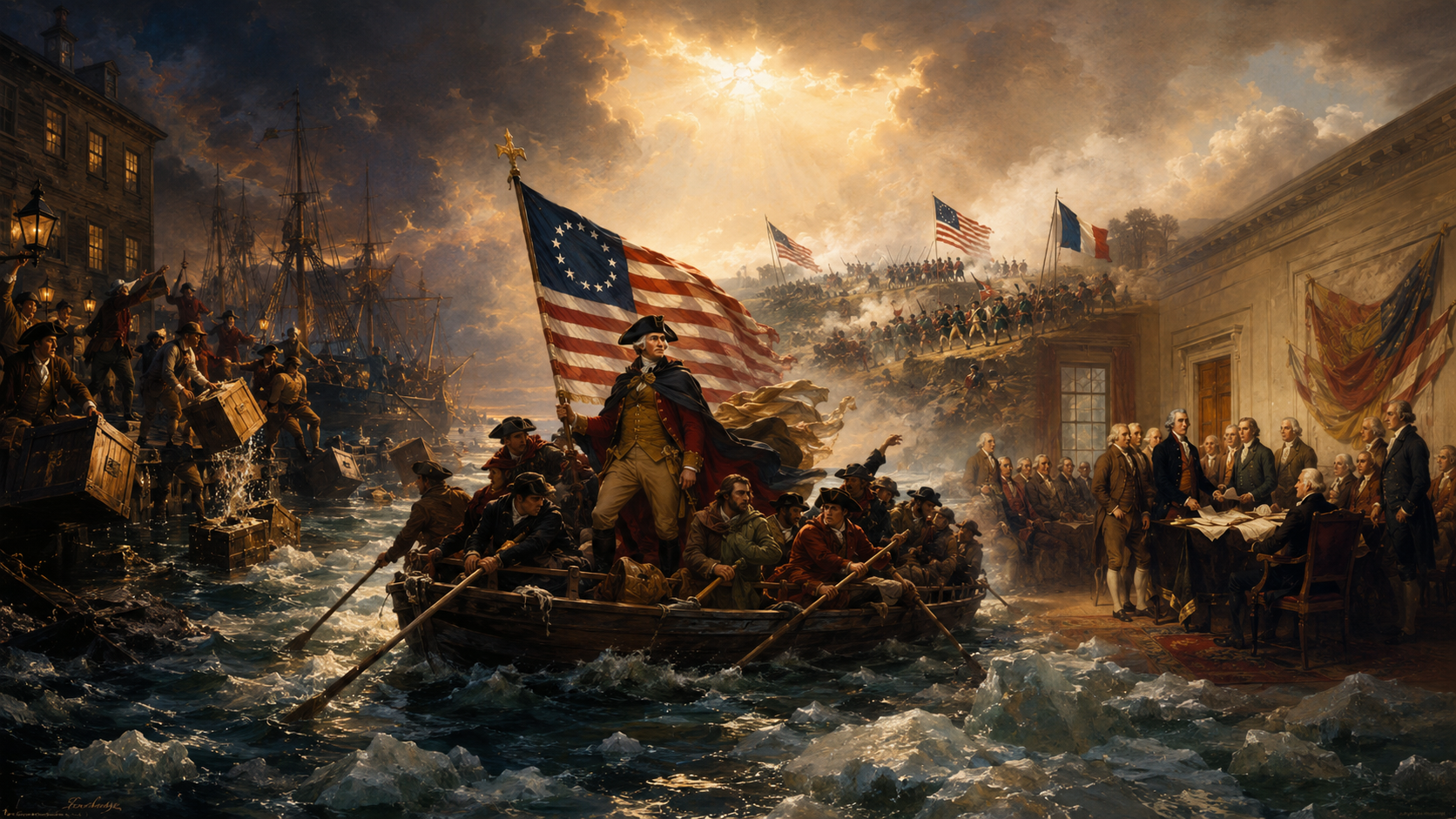
Ten days before the 250th birthday of America's Declaration of Independence, I was a guest of Evelyne Joslain on her Radio Courtoisie program to talk not about the news for once, but to engage on a history stroll through the first half century of the American Republic.
What is essentially a podcast goes over 50 years of American history, from the French and Indian War and the Boston Tea Party through the revolutionary years and the writing of the Constitution until Jefferson's purchase of the Louisiana territory and the Lewis and Clark expedition. (Thanks for the the Instalink, Sarah))
A second podcast, due a month from now on July 22, will treat the next century of American history, from the War of 1812 and the Texas Revolution through the conquest of the Wild West and the Civil War to the closing of the frontier and the Spanish-American War.
I am grateful that we have received lots of congratulations from people who added that they have learned a lot. The podcast is in French, but here are some of the subjects that I mentioned:
• With Britons from the British Isles fighting against Britons from North America, the conflict was often described in the 1770s as a civil war or a war between brothers. As George Washington put it, "Unhappy it is … to reflect that a brother's sword has been sheathed in a brother's breast and that the once happy and peaceful plains of America are either to be drenched with blood or inhabited by slaves."
• The term "Americans" (in centuries past used only for… the Indians) had slowly but surely come to be used for the Britons from North America — by both the latter and by the Britons from the British Isles — to mark the growing difference between — but to what extent is the following description 100% correct? — the two (?) peoples (or the two populations of the same people).
• Why were the colonies so set against taxes from London? Were they ingrates regarding the French & Indian War? The answer is simply that, in the view of the colonists, the empire was sort of like the Commonwealth today. Granted, every member is under the king (George III or Charles III), but: apart from that, every part should take care of nobody but the people within its own domain. Let London take care of the Britons within the borders of England. England should no more make decisions about (and levy taxes on) the Britons in Maryland or in Virginia than Philadelphia should make decisions about (and levy taxes on) Britons in Georgia and in South Carolina — or, for that matter, in… England itself!
• However, we must be realistic, right? Britain is an empire, correct? Now, if you accept this and that, therefore, it needs a centralizing center of power, then fine, by all means let it be London. (Where else would it be?!) But in that case, let it be composed of Members of Parliament not only from Birmingham and Leeds and Edinburgh, but of MPs from all parts of the British Empire around the planet (including the 13 colonies and Québec). To summarize this in four well-known words: No taxation without representation. (By the way, did you know that while none of the colonies on the mainland had a representative in London, the sugar island of Jamaica did have one?)
• What with the redcoats' aim at Concord and Lexington, it turns out that a major reason for the outbreak of the revolution was the government's attempt at (what we in today's parlance would call) gun control.
• What is amazing is the young ages of the founding fathers. At the time of the Declaration of Independence (1776), Jefferson was 33, John Adams was 40, Washington was 44. At the time of the Constitution (1787), James Madison was 36, James Monroe was 29, Alexander Hamilton was 30, John Jay was 41. (And how about Lafayette — how old was he when he became a general in the Continental Army? Read the answer below…)
• Every single sentence of the Constitution provides the same message: that the citizen is a free man
• There are quite a number of parallels between POTUS1 and POTUS47 (aka POTUS45):
— As president George Washington had a powerful message: "The promotion of domestic manufactures will, in my conception, be among the first consequences which may naturally be expected to flow from an energetic government." According to Ron Chernow, George Washington
believed that "commercial connections, of all others, are the most difficult to dissolve," which foreshadowed his faith as president in enduring commercial rather than political ties with other countries.
— Also — just like Trump's bombings taking out Iran's leadership (not to mention his Caracas raid taking out Venezuela's lider maximo) — the Continental Army would deliberately aim for enemy officers; which was not how wars were fought between "gentleman" in those times.
• Used to gather at inns, the Founding Fathers' generation was higher into liqueurs and other types of alcohol than their descendants are two centuries later. Benjamin Franklin once said: “In wine there is wisdom, in beer there is Freedom, in water there is bacteria.” The greatest distiller of whiskey in North America was located at… Mount Vernon; George Washington produced 41.000 liters of whiskey per year.
• After purchasing Louisiana territory, Jefferson offered the post of governor of the territory to the Marquis de Lafayette
• Because it is a French podcast (en français), we focused quite a bit on French subjects such as Louis XVI's military intervention and French officers, notably the nobleman whom George Washington considered a son. Lafayette was only 19 when he became a general in the American army. His own (real) son was named Georges Washington de Lafayette, and the last of his three daughters was named Marie-Antoinette Virginie Lafayette. This led Benjamin Franklin to quip that his wife had only 12 more children to give birth to (in order to have one child named after every state).
• Although it depends on how the statistics are used, there seems to be more more places and townships named after Lafayette than after Washington, Jefferson, or Lincoln.
• How exactly were the Indians' lands "stolen"? By the end of July 1804, after sailing 600 miles up the Missouri River for two months (since leaving on May 21), the members of the Lewis and Clark expedition had not once met a single American Indian.

Here are some related history NP posts written over the past 22 years:
• What Caused Secession and Ergo the Civil War? Was It Slavery and/or States' Rights? Or Wasn't It Rather Something Else — the Election of a Ghastly Republican to the White House?
• During the Winter of 1860-1861, Did the South's Democrats Obtain Their Aim — the Secession of 7 Slave States — Thanks to Elections Filled with Stealth, Lies, Voter Fraud, Intimidation, Violence, and Murder? (Wait 'til You Hear About… Georgia's Dark Secret)
• Wondering Why Slavery Persisted for Almost 75 Years After the Founding of the USA? According to Lincoln, the Democrat Party's "Principled" Opposition to "Hate Speech"
• The Greatest Myth in U.S. History: Yes, the Civil War Era Did Feature Champions of States' Rights, But No, They Were Not in the South (Au Contraire)
• Harry Jaffa on the Civil War Era: For Democrats of the 21st Century as of the 19th, "the emancipation from morality was/is itself seen as moral progress"
• "Break Their Spirit" with "Maximum Warfare": What Nobody Tells You About Reconstruction in the South After the American Civil War
• Why Does Nobody Ever Fret About Scandinavia's — Dreadful — 19th-C Slavery Conditions?
• A Century and Half of Apartheid Policies: From Its 1828 Foundation, the Democrat Party Has Never Shed Its Racist Past
• The Confederate Flag: Another Brick in the Leftwing Activists' (Self-Serving) Demonization of America and Rewriting of History
• How to Prevent America from Becoming a Totalitarian State
• Inside of a month, Democrats have redefined riots and election challenges from the highest form of patriotism to an attack on democracy — And by “democracy”, they mean the Democrat Party
• Why They Don't Tell You the Whole Truth: The 1619 Project Summarized in One Single Sentence
Cliquez sur le lien pour entendre l'émission d'une heure et demie…
Patron d'émission du Libre journal du Nouveau Monde à Radio Courtoisie, Évelyne Joslain est l'auteur d'une poignée de livres sur les États-Unis et l'Occident. Parmi ceux-ci, son chef d'œuvre est paru il y a deux ans. Voici la revue du livre La Guerre Culturelle.