Another year has gone by since we last read about
Le Monde's weekly magazine. See if you can discern any patterns in France's
independent newspaper.…
In issue 38 (November 6, 2004),
the newspaper of reference has Eric Leser interview
Danny Schechter for an article on his
Weapons of Mass Deception and "the excesses of the American media system". (Sample question: "Are the media in the hands of the administration?") Pierre Jullien devotes the archive section to the CFDT union. (Sample caption: "that humanist [secretary general Eugène Descamps] famed for shouting his mouth off was the embodiment of an authentic and generous unionization.")
Echoing François Hollande on the results of the American election (the foremost explanation for the Republican victory, said the Socialists' leader, was due to "the reflex of fear" in America), Issue 39 (November 13) has Edwy Plenel explaining that Dubya's victory is due, basically, to Americans being frightened and/or bamboozled by Karl Rove and his ilk (reality check here), comparing the discourse on moral values with the speeches of Nazi-collaborator Philippe Pétain. (When Bush isn't being compared to Hitler, he is being compared to a Stalinist or a fascist sympathizer…) But the Bush-bashing does not end there.
The issue features Annick Cojean's cover interview with Elton John, in which two pages are devoted to politics; sarcasm concerning the "land of liberty"; condescension regarding a "system" that would allow a man like George W Bush to be elected; self-praise for EJ being "dead-set against the Iraq war from the very beginning"; head-shaking about how one would go crazy if one "lived in America full-time"; harping about "one of the greatest tragedies of all time" (Dubya's election) and for the biased information on American TV channels and the "infinitely dangerous" "mental cases" who work for them. (Cojean even manages to fit in a question concerning criticism of Ronald Reagan.) "Impossible to understand for a European or simply someone with common sense." Notice how a citizen of Europe, by very definition, is a wise, tolerant, and reasonable person with common sense… (Le Monde 2 sure refrained from reporting on whom he received an award from!)
 Before we have a chance to coo over Alain Frachon's photo album on Yasser Arafat coupled with Shlomo Ben-Ami's article on the Palestinian Ra'is, we get to read Jan Krauze's interview of "the American who rejects the American model". Indeed, long-time International Herald Tribune columnist William Pfaff holds that "the leaders of his country are committing a major historical mistake in considering that the United States have the vocation to propose, even to impose, ther model of society to the entire world." Since he says that "people over there [in the U.S.] do not understand what one is telling them"; since he believes that "globalization is destabilizing"; since he claims that the neocons are naive and that "realism" has become a pejorative word in Washington; since he skewers the evangelical movement; since he says that "France has committed some tactical errors but fundamentally its position was just"; since he says that "the fundamental problem is that the United States doesn't understand that the essential cause of the current problems in Iraq is the occupation itself"; since he compares the American way of life to communist totalitarianism ("this manner of considering the American way of life as a stage to come for all humanity, that is the American counterpart of Marxism")… he is a natural subject for an interview by the independent newspaper…
In Issue 41 (November 27), Edwy Plenel complains that in spite of "Michel Barnier having said that France's message has been 'heard'," France is more and more isolated. Ranting and raving that it's unjust, he goes on to suggest that France's position in Ivory Coast is the fault of (who else?) treacherous America. "Isn't that [France's position of a neocolonist power] what the United States was seeking, that opportune ally of Laurent Gbagbo? Install that image, efficient as a caricature: the old colonial Europe face to face with the new democratic empire?" The French are so used to caricaturing Uncle Sam and Bush, and to treachery and double-dealing, that they automatically bestow the same attributes on anybody who doesn't agree with them (by sheer coincidence, this self-serving viewpoint leaves the French — or their leaders and élite — off the hook)…
Otherwise, Corentin Fleury has been kind enough to accompany the "mujaheeddin" in their fight for "besieged" Fallujah; meeting them for real, says the 21-year-old photographer, "suddenly those fanatics had a human face, that of fighters who have crossed three or four countries to 'defend Islam' against, they said, the 'heathens' and to free the country from the 'invaders'." Although the Frenchman goes on to talk about "the young fighters and the foreigners, all those who were ready to sacrifice their lives", the article's subhead does — surprizingly — mention "the fundamentalist Sunni [who] have installed a true dictatorship, multiplying cases of torture and executions."
There is also Michel Guerrin and Emmanuelle Lepic's interview with Gilbert & George, two London-based artists who, not unsurprisingly, are against George W Bush (and the Pope, who should "be sent to the international criminal court for crimes against humanity").
 In issue 42 (December 4), Martine Valo's article on Belgian artists working in France would hardly be complete if they didn't bash Bush, while in Issue 43 (December 11), Pierre Assouline claims that because so many members of the French élite teach in America, there can be no truth to the charge that the French are anti-American. (We also learn that not only Nicolas Sarkozy is known as l'Américain; Nicolas Bourcier teaches us that in Turkey, a writer is also known as "the American". Happily, Orhan Pamuk is against the "terrible" George W Bush "who builds a ditch between East and West".)
Issue 44 (December 18) has articles about 7 Jours au Groland, Canal +'s TV news parody that takes on "the establishment, the free market, the executive class, Bush's policies, comfort and conformity" (Jean-Michel Normand); and buyers in a Paris market asked (by Amélie Amiel and Fabien Breuvart) to take their own photos.
Horrors! In the archives section, Michel Lebvre informs us that the Le Monde 2 weekly had a predecessor in the 1940s (entitled Une Semaine dans le Monde). Listen to a sample sentence: "Le gouvernement des Etats-Unis a enfin compris — puisse le Congrès en faire autant — que l'existence d'une Europe indépendante et relativement prospère importait beaucoup à la paix du monde et à la santé de l'Amérique elle-même ; c'est un premier pas." Does the condescension ring a bell? It's from July 1947.
In Issue 45 (December 24), Edwy Plenel waxes enthusiastically about the lessons of life from two leftist intellectuals, while Simon Roger's archive section takes on Zapata and la revolución mexicana… A week later, Issue 46 (December 31) presents us with the photos of the year 2004. Besides the picture of the coffin of Ronald Reagan is a caption informing us that the president died at the age of 83. As for Edwy Plenel, his editorial on the Bantu word Ubuntu (fellowship) pontificates that South Africa is replete with brotherhood and humanity and that the Reverend Tutu's Truth and Reconciliation Commission is (nudge, nudge) "far from any simplification between Good and Evil". And the condescending editor goes on to add that "In Iraq, liberated but occupied, where the trial of Saddam Hussein is announced before a 'special tribunal' with the option to impose the death penalty, the South African example has not, alas, taught any lessons." Marveling at a supposedly exemplary reconciliation program in Morocco, Plenel goes to suggest that that Arab country has learned more from that example than Iraq or …the United States.
Issue 47 (January 8, 2005) has an Edwy Plenel editorial saying basically that compared with the victims of the tsunami, the victims of 911 don't represent much (although this is preceded by the usual batch of hedges and disclaimers)… Issue 49 (January 22) features Caroline Broué's interview with Baltasar Garzón, the Spanish judge who has gone after former autocrats (Pinochet and members of the Argentinian junta), but has done nothing against current ones (Fidel Castro). Lauding "Chirac, Zapatero, Brazil's Lula, and Chile's Lagos", the good judge takes as a given the Lancet canard that "the liberation of a country [Iraq] cost the lives of over 100,000 people" and says that that is something he "cannot accept". Nor could Spain's highest antiterrorism magistrate accept the 3,200 dead under Pinochet. But the 20,000 under Castro, es un otra historia…
Lucie Werther has excerpts from her journal relating on her experience as a Frenchwoman living in Riyad (the cover article), in which she complains about disinformation about France as an anti-Muslim country. Disinformation — something to fight against. Francesco Zitrola follows that with an article following a team of Doctors without Borders to tsunami-struck Indonesia, in "the humanitarian wave". Unless I am mistaken, apart for the Presbyterian Purse, the words "America", "Americans", "U.S. Navy", "the Abraham Lincoln" are not mentioned once…
The cover story of Issue 48 (January 15) concerns the residents of the rich new boomburbs who voted for George W Bush. Needless to say, Corine Lesnes manages to find a family in Colorado whose children have never been to the East Coast or even abroad. Of course, had the Kurtenbachs managed to travel a bit, they would have acquired the lucid open-mindedness that is so prevalent among avant-garde Europeans and voted for John Kerry. This is followed by Khassan Baïev's testimony from his tour of Chechnya as a surgeon, Philip Blenkinsop's photos from tsuanami-stricken Atjeh (Indonesia), and Mark Power's pictures of the Airbus A380. The super-jumbo (shouldn't we call it the hyper jumbo jet?) being European (and not American), there is nothing about the pollution it will produce.
The special archives section, surprisingly, is dedicated to a single person, and somone by no means considered one of the century's most important leaders. But that's forgetting that Paul Newman is not only a proudly self-proclaimed Democrat, he did things like oppose the Vietnam war and help put the Nation back on track, and above all, he is "ashamed of the aggressiveness of President Bush". Noting that an actor was elected president in 1980, the author bemoaned the fact that that actor was a war-mongering, free-market conservative. Wouldn't it have been much better, for America and for the world, had a Hollywood star with the credentials of Newman made it to the White House? "The 'and if' is fascinating" purrs Jasper Gerard. "Imagine if the leftist screen idol had won over Ronald Reagan, conservative and B-movie actor. How different would the world be?" Imagine: President Newman. Imagine: intercontinental peace and harmony with the entire planet. Imagine: the USSR still in existence. Makes your smile sugary and your eyes water…
I didn't do too well on recording all of the following issues, but relaed to the above, the cover article of issue 58 concerned Hillary Clinton, fawning about her chances in 2008 and how good she would be for America and for the world.
Issue 50 (January 29) has Maguy Day and Stéphane Jungers's map of Iraq entitled "Elections in blood", followed by "the investigation of an Iraqi doctor" on Fallujah, City of Ghosts, a translated Guardian article in which Ali Fadhil describes how the Sunni city was "completely destroyed" and how "the American military have assuredly sown the grains of a civil war".
 In Issue 51 (February 5), Yann Plougastel interviews Manu Chao, aka "the José Bové of music", while Plenel waxes poetically on Florence Aubenas: her rigor and humanity, the coupling of professionalism and generosity in her writings, her laughter, her vivacité, her joie de vivre, her vital militantism, "the disasters of the world and the misery of the present that she enver ceased to confront". Far from us to minimize the drama and tragedy of her and her chauffeur's kidnappings, but this looks like little more than a rehash of the toasts, the celebrations, and the elegies of so many humanists and other "militants" in the past. And what they usually mean is that the people thus lionized were eager to castigate and/or mock America and capitalist society, while ignoring or relativizing the mass murders and other horrors of dictators opposed to Uncle Sam (Stalin, Mao, Saddam, etc).
Besides Madeleine Vatel's article on "the mother of all Russian soldiers" (aka Valentina Melnikova), Issue 52 (February 12) sports an article on "the most famous English-speaking blogger in Iraq". No, it is not Iraq the Model, it is Healing Iraq, and for the second time, Frédéric Joignot writes about Iraqi blogs without mentioning the site(s) of brothers Mohammed, Omar, and Ali. He makes a point of saying that "the Americans find no redemption in [Zeyad's] eyes." In fact, the journalist spends an entire third of his article in recounting the terrible treatment the Baghdad dentist underwent in the hands of four GIs one night, even pointing out the date of the posting so that the average Le Monde 2 reader can find it easily. The rest of the article is made up of three recent posts which pretty much contradict the anti-American emphasis of the article.
My mother was in tears watching the scenes from all over the country. Iraqis had voted for peace and for a better future, despite the surrounding madness. I sincerely hope this small step would be the start of much bolder ones, and that the minority which insists on enslaving the majority of Iraqis would soon realise that all that they have accomplished till now is in vain
But the large-lettered one-sentence excerpts naturally dwell on the problems due to the American intervention.
 Issue 53 (February 17) has Edwy Plenel lecture Bush and Rice about inequalities and a world more unequal than ever. (First he complains about Dubya being a reactionary, now he complains that Dubya wants to reorganize the world…) In issue 54 (February 25), Frédéric Joignot cannot speak with Taslima Nasreen without prompting her to castigate W, serving us the old canard that America contributed to creating the Taliban and the Muslim world's fundamentalists. The atheist Bengladesh writer goes on to claim that "The Baathist party, Saddam's, was a non-religious party [laïque], he opened the university to women, he removed their veils, and now…" (Here is more on Saddam and his family's contributions to feminism and progress in Iraq.) The issue ends with a piece by Pascal Bruckner, the author who tells of the travails he went through for supporting the Iraq War in France.
I learned what it is to get insulted in the street, threats on the telephone. My North African friends told me, "You have brain damage", those of the Esprit review dropped me. … I felt very alone. I asked myself: "Have I made a huge blunder?"
Truly it is nice to hear how open and tolerant the generous, avant-garde humanists are towards the free debate and understanding discussion they are always championing,
n'est-ce pas? Unfortunately,
Bruckner (who has an American, "strongly anti-
Bush" wife) apparently couldn't stand the heat, he did not answer
Non to the question he asked himself, and it is truly disappointing to hear how he has back-pedalled, in order to conform to the usual hems and haws of the
bien-pensants, and issuing the usual batch of hedges and disclaimers:
I am not ready to engage myself for such causes again.
Historical action is something that [only] occurs in America. Unfortunately.
I gave the impression that I was championing a guy like Bush, whom in the final analysis I hate.
By issue 56 (March 5), I was getting tired of recording all the nonsense in Le Monde 2, and I started slowing down. Edwy Plenel waxes on the recently-deceased Arthur Miller and his brilliant battles against lies in politics and the actors who govern us (can
Dubya's name be far away?
non…). There is also a long article on
Clint Eastwood, and since the movie star is known to be rather of
the conservative bent, Samuel Blumenfeld asks him no questions on
George W Bush (unless of course he edited them out before publication). The issue ends with a rather interesting archive section on
les nouveaux intellectuels (including a pro-war piece by
Pascal Bruckner before the unrelenting pressure and the unceasing taunts caused him to relent — see issue 53).
Issue 60 (April 9) has Annick Cojean's cover story on Arnold Schwarzenegger, a Magnum photo reportage on Hezbollah, Martine Valo's article on African singers (Didier Awadi has George Bush jeered in his concerts), and an archive section on the Condor Plan. Last but not least, in a letter to the editor, a Françoise Heide lauds the average French believers who, reminding their atheist counterparts (lauded by Michel Onfray in the previous issue), that "as the well-behaved children of the French Republic that they [the believers] are, very frequently feel the need to tell George Bush to give back to Jesus what belongs to Jesus."

 Issue 61 (April 16) features Dominique Frétard's piece on the Berlin exhibit devoted to art on the Baader gang and a portfolio by the photographer Olivier Jobard on an African migrant's attempts to reach Europe.
 Issue 62 (April 23) features Guillaume Serina's interview with Marcel Gauchet, the philosopher who wants a world government. "The 21st century will be that of the democratic planet", says the writer of the review Débat. The issue's archives section takes on the fall of Berlin 60 years earlier, with much raised heaped upon the Red Army. (Most interesting — especially in view of all the ink that has been used on trying to prove that the raising of the Stars and Stripes over Iwo Jima was staged — is the portfolio showing TASS photographer Evgenni Khaldei and three Russian soldiers carrying a red banner around Berlin [to the airport, to the Brandenburg gate and that, a day or two after the battle was over] before settling on the triumphant picture taken from the roof of the airport.)
 Besides a story on Nollywood, Nigeria's movie industry, in Issue 63 (April 30), we get a huge retrospective on the fall of Saigon. But the best part is that Edwy Plenel takes us to the theater. "What purpose does theater serve?" he asks. "To stir up ideas." So he brings us to a "militant" and "edifying" play, namely Michel Vinaver's 11 September 2001. The Los Angeles première of the play — which (surprise, surprise) likens Dubya to Osama bin Laden — was to be sponsored by …the cultural section of the French embassy in Washington ("which was all to France's honor"), until ambassador Jean-David Lafitte pulled the plugs, an "act of censorship", Plenel informs us (and deplores), "which surprizes us all the more". Still, the "spectacle is reassuring: Vinaver's theater continues to scandalize" although it also means that "one cannot support reality."
 Issue 64 (May 7) has a cover story on Neuilly, "the town that votes for Sarkozy [as National Assembly representative] at a rate of 83%", a typical msm piece by Jean-Michel Normand and Martine Valo quoting renowned pundits such as Olivier Besancenot (the Paris suburb is "a ghetto for rich people", opines the leader of the extreme communist party). This is followed by Frédéric Joignot's interview with a "Euro-enthusiastic" American. Needless to say, Jeremy Rifkin castigates America and… George W Bush. If the EU constitution had been proposed in America, adds the Jimmy Carter fan, "I would embrace the document, thinking I had awoken in paradise!" Then in honor of the 30th anniversary of the end of the Vietnam war, Nicolas Bourcier treats us to Marc Riboud's photos of the era and the photographer's reminiscences (we are told that the "citizen photographer" has an "insatiable curiosity" — as you will readily see) of "Uncle Ho" reminiscing in turn on Hue's high school, the charm of the Perfume river, and Maurice Chevalier; of the Ho Chi Minh trail and how "bicycles won the war" ("it was they, coupled with the courage, that incredible doggedness of the North Vietnamese, which beat the forces in the South [the forces, not the human beings] and the Americans"); of North Vietnamese leaving their shelters to fortify the dike of the Red River ("The dike, that is the survival for the whole country"). "On that day [April 30, 1975]", purrs Bourcier, "a war of 30 years comes to an end", by which time the insatiably curious photographer has already left for other horizons.
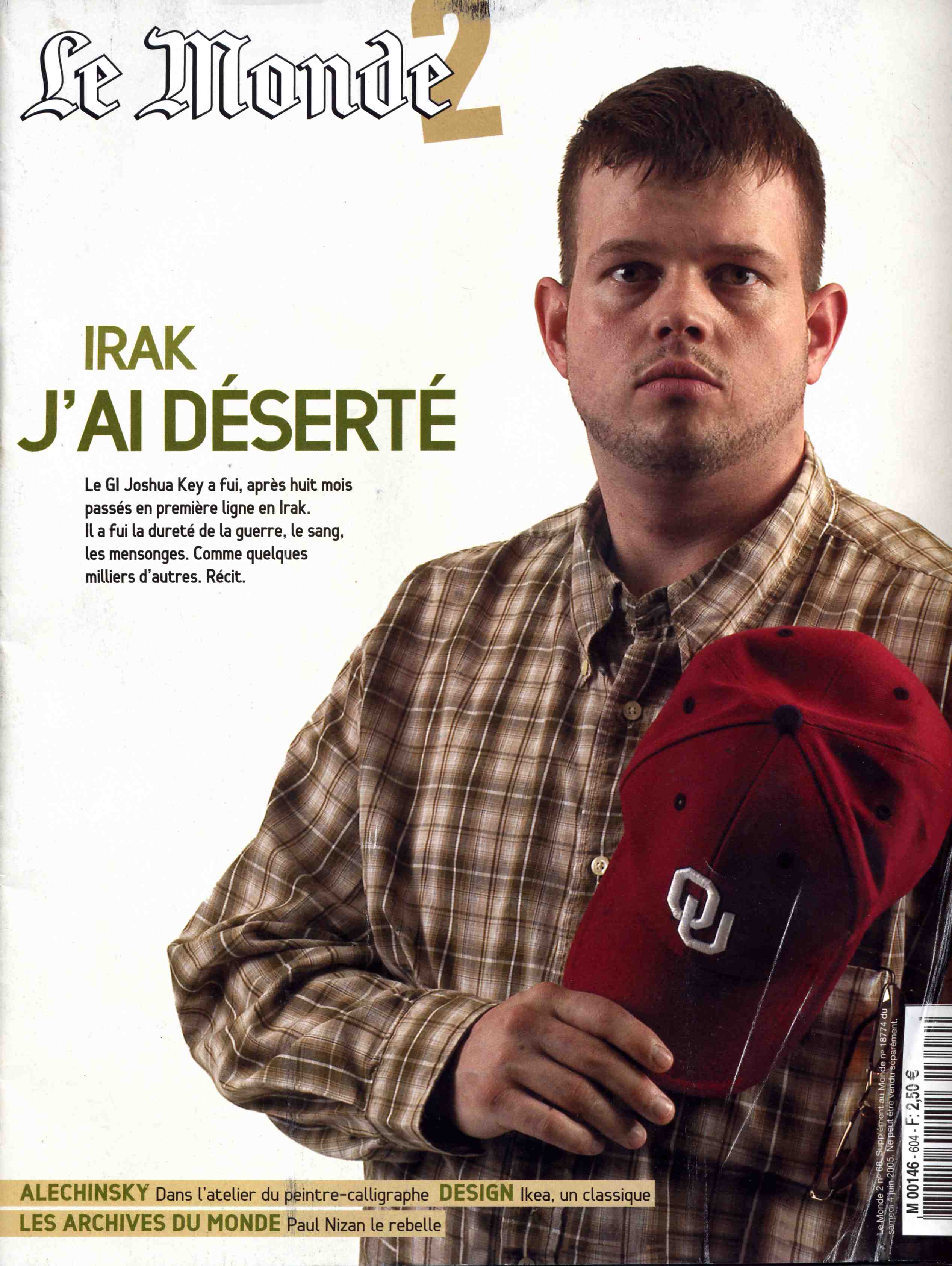 Besides featuring Hassan Musa's Great American Nude, Issue 68 (June 4) finally brings us stories of American heroics from Iraq. It is the thousands of GIs, Annick Cojean tells us, who have deserted. (Who have deserted "the Iraq war, its horrors, its lies".) Catherine Dupeyron tells us of Khaled Katab Mohameed, the Israeli Arab who would tell his fellow Muslims of the World War II Holocaust; and the archives are devoted to the intellectual Paul Nizan, the first of three LM2 archives devoted to XXth century intellectuals (the two others will be Jean-Paul Sartre and Raymond Aron).
In issue 78 (August 13), Nicolas Bourcier interviews Michael Connelly, the detective novel author (Harry Bosch), who manages to …castigate George W Bush. Claudine Mulard takes on Over There, explaining that the FX show presents a war "that is really not nice to look at". "The first episodes of the ultra-realistic [sic] TV series are provoking a wide debate in the United States: is it a good thing for the morale of public opinion, patriotic in some fashion, to show the horrors of war and the numbness of American troops, almost in real time?" Wow. Mulard, like her lucid compatriots, has really hit the nail on the head: if it weren't for Steve Bochco and his TV series, the average American klutz would have no idea that war is hell. In fact, troops in Iraq will be happy to learn not only of their numbness but how their morale is going to pieces: "Won't the realism of the series undermine the morale of the troops, and thus that of America's public opinion, because it exposes the horrors of a war which the American media outlets refrain from covering in its most harrowing details?" Because, of course, if not for American TV stations' "censorship", the situation would become clear as water, clear in its horror, and all Americans could do nothing but join in agreement with the lucid anti-war Europeans and what the latter have learned from their ultra-objective news media.
Besides Alain Frachon's interview with Pascal Lamy, Issue 80 (August 27) sports Frédéric Joignot's article on Nan Goldin. Needless to say, the American photographer compares the "young Christians" in "conformist" America to neo-Nazis, adding "I don't want to live in the United States as long as George Bush, all those reactionaries who wage war on the entire world, are leading this country." This is followed by her trip to France to do landscapes there, with the article ending with the quote, "It's a new spirituality quest." As if you hadn't understood: the way out of, the solution to, the American nightmare is France: lucid, logical, tolerant, reasonable, harmonious France. The issue ends with a collection of articles on Japan and the end of World War II. Among the articles from the Le Monde archives is a February 1995 article explaining that the emperor's kamikaze-flown planes "sank 34 ships before the end of the war, including 33 aircraft carriers [and] damaged 285, including 36 aircraft carriers" (which gives you an idea of the fact-checking forces available in European editorial offices) and an editorial of September 1, 1945, dealing with the expected "horror" of the (coming) occupation and warning that "neither the months nor the years will probably suffice to fill the gap between the two adversaries which their civilization separates fully". Plus ça change… There is also a filler suggesting the Tokyo trials were not as fair as those of Nuremberg and overemphasized coverage of the Hiroshima and Nagasaki bombings (two articles, fours pages, versus one article of four pages for the entire rest of the war, covering the period 1931- early August 1945), with subheads such as "the 'useless' bomb" and including the only really horrible photos of the issue.

 Surprise! The cover article of issue 81 (September 3) features a Nagasaki portfolio ; Frédéric Joignot has an article on the followers of the Raël sect, suggesting that the books of anti-establishment writer Michel Houellebecq are based on their teachings. Fair enough, if true. But it doesn't seem that French society makes a big deal out of all the intellectuals, French and foreign, who through the years based their teachings on the wishes and dictates of Joseph Stalin.
The archives collection of the issue focuses on the birth of Solidarnosc in the Gdansk shipyards 25 years ago. Poles throughout the world will be pleased to learn that Raphaël Chamak and Jan Krauze laud "the stubbornness, the pacifism, and the intelligence of the leaders of the Solidarity union" (emphasis mine), thus suggesting a symbiosis with the anti-war, lucid, and anti-American (sorry, anti-Reagan) forces in Western Europe.
Issue 82 (September 10) is devoted to hurricane-ravaged Louisiana. With Edwy Plenel leaving Le Monde, Jam Krauze takes over, and his first editorial is replete with French paternalism. Wang Fuchun shows off his prize-winning photographs of China's locomotives while Marie Bourreau recounts the story of Sabrina Sagheb, the Afghan basketball player who is the youngest candidate in the legislative elections. Nowhere is there mention of the word America or the war she waged to allow for Sagheb's run, except in the latter's disdainful mention of "the American candidate, Hamid Karzai".
Issue 83 (September 17) features Yann Plugastel's article on the fall and rise of Phill Spector, Jan Krauze's comments on Eric Baudelaire's photos of the ghosts of Abkhazia, and — needless to say — the Alain Salles account of the revolt of America's media:
Showing little eagerness until now to criticize President Bush or to show the horror in Iraq, the most famed TV news presenters have not held back in voicing their indignation [in the wake of Hurricane Katrina]
Most important of all, the cover article concerns Annick Cojean's story about, and exclusive interview of,
Hamid Karzai. In striking contrast with French reporters' relations to French politicians and members of the elite (see, for instance, Olivier Todd's description of Jean Daniel in issue 85, below), there is barely a single of her 26 questions with Afghanistan's president over four full pages that does not display deception, pessimism, cynicism, mistrust, and/or smugness. A patient and "always optimistic"
Karzai (to noone's surprise) holds his own. The issue's other bright spot is
a 1971 interview with Louis de Funès, in which the star comedian defends popular comedy as opposed to the mockery and snorts of the Left's
artistes engagés — "laughter at the expense of others, sad laughter, that makes you want to cry".
 Prior to Nicolas Bourcier's cover article dedicated to China's influence in Algerian city-building, Issue 84 (September 24) starts out with Alain Frachon's column concluding that if America ever had a "great" president, it was not Bush but Clinton. Follows Frachon's interview with Senegalese writer Ken Bugul, Mattea Battaglia's portfolio of Vincent Prado pictures from his three-year stay among the Maoist guerillas of Nepal, and the archive section dedicated to John Lennon, featuring a 1966 article by Bernard Cassen, many years later president of Attac.
 The cover article of Issue 85 (October 1) concerns Matthieu Auzanneau and Guillaume Serina's study on the coming end of the petroleum era. Enough said. While Michel Philippot narrates a portfolio of Brassaï photos, Baudouin Eschapasse has an article on Deep Springs College, "the most prestigious, the most selective, and the strangest school in America." Or: Heidegger with the cowboys…
Speaking of intellectuals, this week's issue features excerpts from Olivier Todd's auto-biography. The son-in-law of Paul Nizan, "incarnation de l'intellectuel engagé", and the father of Emmanuel Todd, Olivier tends to prove that intellectualism in France is a family affair (or should that be a clan affair?). His account of editor Jean Daniel's audience with John Paul II can perhaps be called typical of French journalism:
Jean entitled his article "What the Pope Told Me". Actually, it was mostly about what Jean Daniel had told the Pope.
The elder
Todd's most revealing moment, and neither he nor any of his editors (at the book publisher or at Le Monde 2) seem to realize it, comes when he describes the "autocrate eclairé" at Le Nouvel Observateur:
Admiration came easily to Jean [Daniel]. Philosophers as well as politicians, writers as well as philosophers, bowled him over. Those luminaries, Camus, Sartre, Malraux, Pompidou, Giscard, Mitterrand, Foucault, communicated, via porosity, a touch of their talents to him. If he returned from a trip abroad, Jean immediately went to a [government] minister to share his impressions. He made a report.
Then, there is the archives section on the 40th anniversary of coup d'état in Indonesia, the overthrow of Sukarno, and the beginning of the reign of Suharto, with special emphasis, of course, on
Washington's role in this "witch hunt". The massacre of thousands of PKI members and sympathizers is depicted as gratuitous without the slightest attempt to touch on the behaviour and attitude of their fellow communists in places such as the Soviet Union, China, and Vietnam.
Speaking of China, for the past few weeks, Le Monde 2 has featured a three-panel comic strip by Marjane Satrapi. The feminist caroonist from Iran ends this week's offering with the following nuanced question
outside of 4-euro T-shirts and 12-euro pairs of shoes, I wonder if it is better to be invaded and dominated by 300 million puritans [America] or by 1 billion atheists [China]?
Hmm. Wonder what the Dalai Lama and the Tibetans would have to say to that piece of moral relativism…
Issue 86 (October 8) features Samuel Blumenfeld's cover article on "God Against Darwin" — subtitled "Bush's America Assault on Evolution"; Jan Krauze couples an editorial ironizing about the new democracies in the former Soviet Union with an article on the Kremlin's gulag; Annick Cojean takes a bite out of Mireille Guiliano's French Women Don't Get Fat.

 Issue 87 (October 15) features Martine Valo's story on migrants who have made France their home. Michel Philippot has a gallery of Willy Ronis's photos. Jean Guiloineau has translated Romesh Ratnesar's Time Magazine article on Condi Rice. And Samuel Blumenfeld has an article about what Jane Fonda does not reveal in her autobiography. Even though it reveals that the star "has shown amnesia regarding the most extremists aspects of her political engagement" (the FTA [Fuck the Army] Show, Steelyard Blues, or Letter to Jane, for example, are either ignored or receive but cursory mention), do not expect a conservative reading. Blumenfeld's phrases and sentences include "the American horrors in Vietnam", "the soldiers revolted by the war", and "an actress who found the courage to stand up against the Vietnam war." As for "the actor and director of The Green Berets (1968) — his famous propaganda movie in favor of the American presence in Vietnam", he "is far from having the most nuanced analysis" of the situation and after "Jane Fonda's arrival in Vietnam, John Wayne no longer monopolizes the airwaves." In sum, it amounts to "this aspect of her militantism has been largely struck from her autobiography, as if the extremism that she displayed in a certain era no longer is presentable." In other words, American society — blind, hypocritical, unwilling-to-face-reality American society — is responsible for forcing a courageous actress to lie by omission.
 Issue 89 (October 29) gives us Guillaume Serina's interview with Philip Meyer (The Vanishing Newspaper), Philippe Ridet's portfolio on Doctor Nicolas and Mister Sarkozy, Camilla Panhard's article accompanying Mat Jacob's photos of a Muslim community in Mexico ("Allah in the land of the Maya"), Alain Salles' article on Kayla Williams, the former GI in Iraq who "dares break the law of silence" (Love My Rifle More Than You), an archive section devoted to the mystery surrounding the kidnapping and murder of the Algerian leftist opposition leader, Mehdi Ben Barka (one of the sections is entitled "From Mossad to the CIA"), and Annick Cojean's interview with Zaher Shah, most of whose focus is based on the fact that Afghanistan's king speaks French, studied in Paris, and met people like presidents Auriol and de Gaulle ("His reference remained la France").
In Issue 90 (November 5), Jan Krauze lionizes Robert Fisk and his latest book, Bruno Hadjih paints "another viow of Islam", Samuel Blumenfeld interviews Pierre-Andre Taguieff about "demented" conspiracy theorists, and the archives section is devoted to the Nuremberg trials.
We will back track a little, and end this list with Issue 88 (October 22).
Astonishing to see that issue's cover: A black and white photo of Saddam Hussein and the words "The Woman Who Accuses Saddam Hussein"! Have they gotten it, finally? Has the newspaper of reference gotten it? Nicolas Bourcier's article concerns Hania Mufti, the Jordanian at the head of the Iraq file at Human Rights Watch: "The British and the Americans [were able to use her documentation] when the turn came, in early 2003, to justify the invasion of Iraq. … Does she think she may have been manipulated?" Sigh… You won't be surprised that Bourcier refers to the American soldiers as "the occupation troops" and that his piece ends with a comparison between the abuse at Abu Ghraib and the "torture methods of Saddam". In-between, the article goes on to document how Hania Mufti feels let down by the fact that she is not part of the trial of Saddam Hussein, and how that felt like "a slap to the face"… it explains how Iraq was supported by Uncle Sam during the war with Iran. This is intersperced with details of Saddam's horrific crimes. Without saying so outright, Bourcier suggests that it is all America's fault, even if indirectly.
Not once is the word Europe mentioned in Le Monde's article.
Not once is the word France mentioned.
Not once is the name Jacques Chirac mentioned.
Not once.
Le Monde.
France's independent newspaper.


